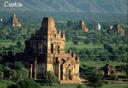
Brick Pagodas in Burma
July 8 - 20
Exotic Burma. More foreign to my mind than Thailand, I think, because all I have of Burma are snatches of phrase and poetry; "the Burma Road", "On the Road to Mandalay, where the flying fishes play.." and for Thailand I have the entire story of Lenna and the King of Siam, played by Yul Brynner, of course. But of Burma I actually also knew that there had been a major uprising for democracy in 1988 and thousands were shot in Rangoon; that Nobel-Prize-winning Aung San Suu Kyi, democracy movement leader, had won election by more than 80% but had been denied the ruling seat by the military junta, and had been under house arrest for years, was released and holding weekly public audiences in 1995 or so, but was re-arrested just a few weeks before we began this journey; and that the country's government is cited with horrendous human rights abuses, is condemned and boycotted by several nations, and is not officially recognized by the USA.
We flew from Kuala Lumpur to Yangon Tuesday, July 8th. We'd been advised by a traveler on Kerhentian Kecil to go directly to Richard at the USA Cafe. Richard is a Seattlite of Chinese descent and we received the most effusive greeting you can imagine. Before you know it we were installed in a bedroom in his house, above the restaurant, and thoroughly engrossed in his family's life. Before we learned how other Burmese families fared under the rule of the military junta, we learned how Richard's familiy fared under the rule of the US government. It seems Richard was having some difficulty getting his US citizenship papers for his younger son and the US empassy in Yangon wanted a complete chronology of his and his wife's whereabouts during the year before and after the child's birth. Richard tended to get caught up in anger at the unreasonableness of the request, so I helped him and his wife May focus on the task and we prepared a declaration with a straightforward chronology of their marriage since 1993. When we delivered it to the embassy, we were told Richard would have to wait a month for a response. I hope it goes well for them.
We learned that one of the things the Burmese government, the State Law and Order Restoration Council (SLORC), did was change the name of the country to Myanmar and the names of many cities, including changing Rangoon to Yangoon. However, this was not a problem for most people. Burma and Rangoon were British names, left over from colonial times; the people had always called them Myanmar and Yangon. But for some of the older people especially, who remember the kinder government under the British, long for the colonial names as a way of separating themselves from the SLORC. The people cannot critize the government or discuss it with foreigners; SLORC spies are everywhere, and people are truly frightened to speak, although they want to. Sometimes they take a chance, but only when no one else is around and only with frequent glances around to be sure the coast is clear.
(At this point Mary Lou excerpted a large portion of Lonely Planet's guidebook chapter "Facts about the Country". For that chapter click here.)

We took a night bus up to Mandalay, not the 'road'. Kipling wrote about the Ayeyerwady (Irrawady) River, but a 'highway' so narrow that meeting vehicles each have to put 2 wheels on the strong shoulder for there to be room to pass. A woman who owned a restaurant in Mandalay told us about how the SLORC had told everyone they must leave a certain town near Bagan and in a few days the town would be leveled. She and everyone were suddenly homeless so SLORC could create a five star tourist area. Through the help of family and friends she was able to start over in Mandalay, but not everyone fared so well. People with no one to turn to were simply shot when the leveling began. Others in Mandalay told us about the constant fear of being watched and caught in some minor indiscretion; people sent to jail who are unable to buy their way out may serve their terms or may be killed. Also it seems an anonymous package was sent to some government official's home recently, which exploded and killed his daughter when she opened it, and in retribution all the schools in the country were closed. No one knows when they will be reopened. And in Yangoon, in April, Aung San Suu Kyi was rearrested to house arrest, and the street to her house blocked off and surrounded by soldiers, so she is no longer able to speak to the people. But in the midst of all this tension, the people of Myanmar are able to go about their daily lives smiling, enjoying each other's company, and being eminently gracious hosts.
Daily life in Mandalay is so foreign to my experience that I was startled into a week of staring. Somehow even life in the moutains of Irian Jaya seemed more up-to-date than that in the remote areas of Myanmar and even in the country's second city of Mandalay, a city of a million people. In the mornings we were awakened by the calls of vendors walking through the neighborhoods with their wares on their heads. "Pineapple, banana, mango" they may cry, in a sing-song voice, or "hot noodle soup". The procession starts about 6 am and continues through the day. Then you hear the clip clop of horsecarts and the jingle of the trishaw bells. If you look out on the street you see a traffic jam of bicycles, trishaws, pick-up style buses and occasional motorcycles, but not enough motors to make the usual noise in a traffic jam. If you go over to the market, as everyone does in the morning, because most do not have refrigerators and the electricity is sporadic anyway, you see fruits, vegetables, fishes and meats spread on papers on the dirt street, with vendors ready with theirr balance scales to weigh out your purchase. You can sit on a six-inch stool and eat delicious noodle soup with coconut milk, buffalo meat and crisp fried dough cut on top like croutons for 20 kyat ($.10US). We took a trishaw tour of the city, Bob applied gold leaf to a very special buddha image along with a crowd of men - women not allowed, and viewed the city from the top of Mandalay hill - a lovely, non-electric sight.
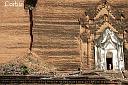
The next day we rode a boat on the Ayeyerwady River up to the town of Mingun. On the powerful, wide river, the trip up took an hour, the trip back took 15 minutes. Both Bob and I felt a thrill actually floating on this historic water. Mingun, like most towns in Myanmar, including large partso of Mandalay, is little more than a village with homes made of bamboo and grass mats. Mingun also has the beginnings of a huge ancient temple, which was badly cracked in an earthquake in 1838 and has not really been repaired. Most burmese are Theruada Buddhists, more austere and ascetic than Mahayana Buddhists, and as best I can tell focuses on cause and effect, ie, doing meritorious acts and forgoing selfish desire will lead to Nibbana. Such things as putting gold leaf on buddha images and making offerings of flowers, incense and water wualify as meritorious acts, but "right livelihood, right action and right speech" are in there too. Boys are obligated to serve a novitiate period in theirr childhood - we saw monks who appeared to be four years old, but most novitiates were seven to ten - then serve a longer period of a few months after they are twenty. Some serve many times, and of course a small percentage are ordained for life. Monastic life is difficult, with over 200 rules of daily life to follow, including not eating after noon, and according to Therauada Buddhism they are not supposed to actually beg. So they make their presence known and hope people will provide their daily needs.
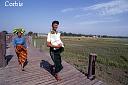
After Mingun we went to Amarapura, a river town noted for its 1.2 KM long and rickety teak footbridge, the longest teak span in the world. It was really quite nifty, with rough planks moving underfoot and no railings on the sides, but many many people crossing by foot and bicycle to and from the island village of 3000 people.
In Mandalay we met Annick, a young woman from Paris who enjoys playing games, and we spent several evenings over cards teaching cribbage and learning Belotte, a game in which the sequence of the cards is tricky to learn, but should be a good four-handed game once we get it down pat. After Mandalay we went to the Iule Lake in the Shan State in eastern Myanmar. None of the border areas are accesible to tourists in Myanmar, and the eastern Shan State is no exception, but we were allowed to go as far as Taunggyi. The Shan State and other border states in Myanmar are still the sites of insurgency against the SLORC and opium traffic, and the SLORC does not want travelers to witness the firmness with which they quench the insurgents or the involvement they have with the drug trade.
The Iule Lake area is very rural and mountainous. Villagers on the huge shallow lake make their living fishing and raising tomatoes and islands staked in place with bamboo poles. The people travel about in narrow, shallow dugout canoes, paddling either with arms or legs, and poling along the bottom. Wealthier people have larger long tailed boats, with deisel engines sitting inside the stern of the boat and a propeller on a long shaft at a flat angle into the water. We took a boat trip around the lake for several hours, once getting snared in floating vegetation and spending about half an hour poling free. We stayed in the town of Nyaungshwe, in a guest house next to the canal to the lake where women washed clothes, men and boys fished with drift nets, and cargo was loaded onto long tailed boats all day long - crates of tomatoes, cabbages, cheroots and bundled and tied pigs who screamed noisily in the process. Next to our hotel was a cheroot 'factory', where a family dried and rolled the lake tobacco into bulky cheroots that we've seen so many men and women smoking throughout Myanmar. On the lake was a monastery where the monks have taught cats to jump through hoops, but I have no idea why.
We went to the market at Pindaya, a mountain town that attracts hill tribe people on market day, and also watched parasol makers at work, the highlight of which was observing the use of a foot-powered bamboo lathe to turn the handles, finials, and spreader core of the parasol. The man even made a small flower vase for a present for us. As everywhere we've been, including temples and monestaries, we were served tea and snacks and practically forced to sit down. Even if you go into a more modern shop, say in Yangon, you must sit while your purchase is packaged and the bill prepared, or at a tiny stall in front of a temple, you must sit on the floor while negotiations are finalized. Every encounter changes from a business transaction to a friendly visit. The pace is slow, extremely slow, but more full of kindness than you can image.
We also went to Kalaw, to market, and to visit the Kalaw Catholic Church, mentioned in Lonely Planet as having lovely images from Italy and a garrulous priest. The road to Kalaw, another mountain town, is crowded with ox carts and horse carts. Along the shoulder of the road deeply rutted tracks parallel the way where the carts have to leave the road to make way for the logging trucks, occasional autos and overloaded buses. Cargo trucks are overloaded, too, creating a center of gravity so high that topples are not uncommon on the mountain curves. We saw one truck flat on its side on the edge of a road with about forty people sitting on the hillside waiting for something to be done. We stayed one night in Kalaw and met people at the market who had walked a long day to get there. Different tribes are distinguished by their different costumes and especially headdresses.
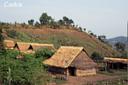
At the Catholic church Father Paul greeted us warmly and told us even more of the difficulties of the people under SLORC. For example, in the Kachin State in Northern Myanmar, there are about 700,000 Catholics. The SLORC thinks that if all the people were Buddhists, there would be no opposition to its rule. Of course, their logic doesn't follow, because about 80% of the people (more than 90% according to Father Paul) voted against SLORC in the election in 1990 that the SLORC invalidated. So in Kachin State SLORC wants to dispense the Catholics and periodically announces that certain areas will be razed and the people will be moved. They are shipped to camps where they get little food and unhealthy accommodation and many die from the conditions. The church tries to get together enough money to feed such people and provide necessary clothing, but it is very difficult. In Kalaw the church is now building a medical clinic where they hope to be able to care for people free of charge; at the government hospitals people are attended to but medicine is not available. People are given prescriptions then sent out to find the drugs, which are out of date if they are available at all, and of course people can't afford them if they can find them. When I asked, Father Paul gave us an address to which we can send contributions. We must send to a missionary center in Detroit which has found a way to get the money to Myanmar. If we tried to send directly to Kalaw church Father Paul would have to wait months to cash a check and fill out numerous forms asking questions such as why are these people sending you money. An answer such as common charity would not pass muster. At any rate, we intend to make a contribution through appropriate channels and will ask others if they would like to join us. It will be a small way to try to make up for the proportion of our money that has gone to support the SLORC while we were in Myanmar.
It actually has felt very strange, here, in a way it may be something like African American people felt in the south in our country for so many years. In Myanmar "tourists" or "foreigners" are restricted from doing many things local people can do, and there are signs most places you look reminding that foreigners must pay to enter pagodas, foreigners may not ride the public boat on the Ayeyarwady River, foreigners must use a certain toiled in a line of 'foreign', 'men', and 'women's' stalls. A significant portion of every dime we spend goes directly to SLORC, which is why it was such an ethical quandry to come to this place, but the balance goes directly to the local merchant, which helps that one considerably. We've minimized our contributions to SLORC by avoiding government hotels and transportation, trying to use public transport whenever possible and buying souvenirs and eating from sidewalk vendors, but we know SLORC has benefited from our presence, too, and contributions to Father Paul's efforts will help ease our minds and help the people as well.
On to the next journal
Back to journal index page
Back to map page
Back to alan's home page