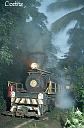
Night Train in Asia
July 21 - 28
When we completed our visit to the Inle Lake area, including Pindaya and Kalaw, we shared a car to Thazi, west of Kalaw, to take the night train back to Yangon. Once in Yangon, we arranged with May to do a souvenir shopping trip to Bago the next day. We picked up bargain after bargain, because of May's expertise at bargaining and her willingness to buy in quantity so she could sell in the USA Cafe. We also saw the highest pagoda in Myanmar and the largest reclining buddha. It was clear from May's face that it was an important place to be. Cash offerings may be placed in any of several boxes. Each box is designated for a special purpose. Those who offer to support the cost of electricity believe they may become wise; those who offer to maintain the image believe they may be blessed with long life, etc. This is of course the same at all pagodas and temples.
After an emotional farewell with promises to meet in Seattle, on Wednesday, July 25th, we left behind Richard and May and kids in Yangon and flew to Chang Mai, Thailand. Chang Mai is a northern city near the mountainous area where many hill tribes live not far from the famous 'Golden Triangle' where Myanmar, Thailand and Laos meet and the opium trade is hot and heavy. On the Thai side, opium growing is now forbidden by law, but soldiers on the roads in the area of the Golden Triangle check all vehicles at least briefly before letting them pass. We took a day tour to the Golden Triangle and to some hill villages, and met people of the same tribes as those we had met in the Shan State just over the border in Myanmar. We went to Mae Sai, the northernmost point in Thailand and one of only two permitted land crossings back into Myanmar, but since we'd just been there we didn't cross the bridge but satisfied ourselves with buying a few Burmese souvenirs we'd neglected while we were there. At the Golden Triangle we took a short boat trip on the Maekong River, and at a riverside stilt shop we crossed a bamboo plank bridge to step foot on Lao shore for photos. Again at the Maekong we experienced a moment of some kind of powerful impact, as we realized the meaning this river had for so many generations of peoples.
Back in the town of Chang Mai we dealt with mundane things like camera film and filters and airline tickets, but we had a splendid day trip out of town to do a raft trip on a bamboo raft down the Mae Kok River - great fun, water splashing up between the bamboo poles that made up the raft, one of the propelling poles being swept out of our boatman's hands to float down the river behind us, and an elephant show and ride at a camp where they train elephants to work in the logging industry. The elephant ride was great fun, although slightly unnerving on the downhill bits when we felt as if we might slide off the seat down to the ground, but the show part made us feel a bit sorry for the dear creatures forced to prance through their paces day after day. Nonetheless, I got a kick out of feeding them bananas, which they snorted into their trunks with major slobbing drools before plopping them into their mouths unpeeled.
We decided we had time after all to do a couple of days in Vientienne, Laos, before moving on to Vietnam, so made arrangements for flights before leaving Chang Mai, and also arranged for a couple of days in Bangkok so we can go to the bridge on the River Kwai.
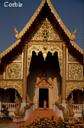
On Tuesday, July 29, we took a tuk tuk tour of Chang Mai temples, only a few, to notice the difference if any, between Thai temples and Burmese temples even though they are both for Therouada Buddhism. My impression is that the Burmese temples emphasize stupa shaped pagodas, and Thai temples include some stupas but emphasize buildings with special rooflines and more dragons. I have not yet learned the significance of the dragon, but the Thai temples and the Burmese temples both have pairs of lions in front of them, and we were told the story of the significance of the lions.
We had an up-close look at the oldest temple in Chang Mai, that we'd been seeing from our hotel window and that was built in 1300 something. And after we were through with temples, we went to a handcraft shop in which all goodies are made by the people of the hill tribes and proceeds from the shop go to help the hill peoples maintain their lives without being overrun by tourism and commercialism. Of course, selling their wares in this shop is much more touristy and commecial than trading the same goods for rice, pigs or wool, but it may be as close to autonomy as these people can come in this modern, fast-moving Thailand. Income from these goods also replaces income from opium farming, which is now outlawed in Thailand. I haven't heard from any people, but from the number of opium pipes I've seen for sale I am guessing that efforts to sell handcrafts do not dissuade all opium trade.
In the afternoon we flew to Bangkok and put in for the evening at Mam's Guest House on Kai San Road, clearly a backpacker's hangout catered to by cheap lodgings (140 baht = $4.66 US), western food adequately prepared, souvenir shops open late at night, and video movies of US recent films showing throughout the evening at the numerous open-air restaurants up and down the street. As I write tonight I'm looking at Twister and having a beer downstairs in the cafe below our third-floor room where Bob is having an early night's sleep.
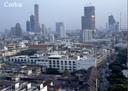
Today, July 30, we took a tuk tuk tour of Bangkok's main temples (do tour guides do church tours in cities at home?) and tailor shops - transit from one place to another is expensive by the little three-wheeled, 2 cylinder open-air tuk-tuks unless you stop at a tailor shop on the way, in which case it's only 10 baht ($.33 US) - and then took a river taxi ride from one end of the route to the other to enjoy the sights of people who live on river stilt houses or live on banges or tug boats right in the middle of this large city, interspersed with sights of elegant temples, modern condominium towers and sleek office skyscrapers. The Thailand we are seeing is no very unlike home, but a few hints of earlier times remain. The street sweepers are not big, noisy trucks, but are people - mostly women - with noses covered against the dust and exhaust fumes wielding straw brooms and dustpans, and both a flower vendor and a broom vendor pedaled by today calling out their wares in musical tones while maintaining their pace in their pedal cycles with huge sidecars. But the first voices in the morning are of motors, not voices or morning coughing as in Myanmar and the internal combustion engine is a gigantic indication of a change of life.
I think of all the people in Myanmar and Irian Jaya, without such machinery and it seems to me as earthshaking an event as the switch from hunting and gathering to the development of agriculture. A fellow in Myanmar who had spent a few years studying at Cambridge told us he didn't think Myanmar would be able to keep it's culture very much longer - the men would want to wear trousers instead of the Longyis - and the women too - and I fear Thailand may be a glimpse of life to come for people in Myanmar. The quandry must have been the same for those who emigrated to the US, our ancestors: is it necessary to give up tradition completely for the sake of economic gain? and hunger may have provided the answer.
On to the next journal
Back to journal index page
Back to map page
Back to alan's home page