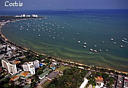
Pattaya Bay
July 30 - August 3rd
On Thursday, July 31, we joined a few other travelers for a day trip down to Pattaya Beach, southeast of Bangkok. Unfortunately, it's been monsoon time for a couple of weeks now, and it was a cloudy and drizzly day at the beach. But we took a boat out to Coral Island, 45 minutes offshore, to do some snorkeling, and had a dandy time. The water was not clear because of the cloudiness and lack of direct sunlight, but we enjoyed swimming around and had a good time getting to know the other folks on the boat, who were from Northern India and South Africa. The day was a lot of travel hours per beach hours, and I don't recommend that people do it in a day trip, as we did. We returned to the guest house in Bangkok about 10 pm, looking for somewhere to have supper.
The next day was our looked-forward-to jaunt to the bridge over the river Kwai. The river is actually named Khwe Yai, and the bridge currently standing has much new construction after the allies bombed the earlier steel bridge in 1945. The original bridge, built by POWs in starvation conditions, was all wooden construction. A museum shows dozens of photos and paintings of the POW campst and prisoners that are heartbreaking to look at.
(Excerpt:)
The so-called Bridge Over the River Kwai may be of interest to war historians but looks quite ordinary. it spans the Khwae Yai River, a tributary of the Me Klong River, a couple of km north of town - Khwae Yai literaly translates as 'large tributary'. It is the story behind the bridge that is dramatic. The materials for the bridge were brought from Java by the Imperial Japanese Army during heir occupation of Thailand. In 1945 the bridge was bombed several times and was only rebuilt after the war - the curved portions of the bridge are original. The first version of the bridge, completed in February 1943, was all wood. In April of the same year a second bridge of steel was constructed.
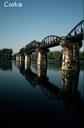
It is estimated that 16,000 POWs died while building the Death Railway to Burma, of which the bridge was only a small part. The strategic objective of the railway was to secure an alternative supply route for the Japanese conquest of Burma and other Asian countries to the west. Construction on the railway began on 16 September 1942 at existing terminals in Thanbyazayat, Burma, and Nong Pladuk, Thailand. Japanese engineers at the time estimated that it would take five years to link Thailand and BUrma by rail, but the Japanese army forced the POWs to complete the 415-km railway, of which roughly two thirds ran through Thailand, in 16 months. The rails were finally joined 37 km south of Three Pagodas Pass. Much of the railway was built in difficult terrain that required high bridges and deep mountain cuttings. The River Khwae Bridge was in use for 20 months before the Allies bombed it in '45.
Although the statistics of the number of POWs who died during the Japanese occupation are horrifying, the figures for the labourers, many from Thailand, Burma, Malaysia and Indonesia, are even worse. It is thought that in total 90,000 to 100,000 coolies died in the area.
As expected, we heard people whistling the theme song from the movie as we were walking across the bridge. Now that we know the real story, it's probably time to see the movie again with new eyes.
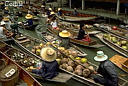
The bridge is in Kauchanburi province, which is northwest of Bangkok. On the way to the bridge we stopped in Ratchaburi province to visit the floating market on one of the canals (khlongs) in between two villages. It was great fun to watch the exchange of fruits, vegetables, fresh meats, fishes and ready-to-eat foods among the many boats gliding silently through the water. It also seemed to be a place where folks met and caught up on each other's news; some boats would stop along side each other and the people would visit for half an hour or so. A marvelous, colorful sight, just like the pictures you've probably seen. It was also another view of a quieter, slower pace of life than ours or that of Bangkok, for that matter.
On the evening of our last day in Bangkok, 2/8, we ate at the restaurant Guiness says is the largest in the world, Tum Nak Thai; it can serve up to 3,000 people at one time. We spent a few hours eating a huge seafood platter of lobster, clams, squid, mussels, oysters and white fish, watching traditional Thai dancing, and enjoying the team of rollerskating servers zooming by as they raced back to the kitchen for their next platters to deliver. All tables are outdoors, but under high roofs in ease of rain, on wooden platforms built over water. Trees are full of twinkling lights and the music is traditional instruments. It was a great evening.
My impression of Thailand is of a place that has come of age with the hoardes of tourists. If the tourists had not been there, the direction of development may have been different. Instead of knowing the jargon for restaurants, temples and tours, young entrepreneurs may have known the jargon for computer programming or avionic engineering. On the one hand this focus makes getting around easy for travelers; on the other, the persistant selling is extremely wearying and difficult to turn off. It's sad to see the older members of hill tribe villages prancing about in their traditional costumes only for the sake of the tourist dollars for the photos, while the young ones are off to work in travel agency offices in the cities. But all in all, from the little we saw in our short time there, I think Thailand has the ability to teach us about our interactions with each other and which things in this life are more important than others.
On Sunday, 3/8, we flew to Vientiane, Laos, for a few days. We had been encouraged to go to Vientiane by travelers who heard how much we had enjoyed Mandalay. Vientiane had more motorized vehicles than Mandalay, but not by much. We stayed the first night at the Metropole Hotel Guest House, not fancy and not so clean, but it had a window, for 1,000 Kip a night (about $1). More people in in Vientiane speak French than English, beacuse it was a French Colony, but if one person doesn't speak English that one hurriedly fetches one nearby who does, so our limited language ability is no problem.
A fellow at the laundromat in Bangkok had recommended that we stayed at La Terrasse, whicc we asked about all the first day and the morning of the second, but finally found it and determined it was restaurant only with a big house to let on the Mekong River. Made sense for the fellow with his children, but for us, too expensive. We moved on to the Pangkahm Guest House on a side street, quiet, and did very well.
(Excerpt:)
The image that figures like these conjure up is one of grinding poverty and unremitting struggle. It comes as a surprise, then, to find Laos to be one of the most civilized countries in Southeast Asia. The towns are elegant and refined, largely untrammelled - so far - by the scourge of thoughtless redevelopment that has so scarred the other cities of the region. The pace of life is leisurely; the food is sophisticated; the Lao are welcoming and relaxed; and there is a sense of style that is absent elsewhere. Foreign residents of Vientiane, Luang Prabang and Pakse revel in the thought that expats in cities like Bangkok and Singapore regard living in Laos as the equivalent of being sent to Mars. They treasure the anonymity of their secret paradise. On paper Laos may, in UN parlance, be a least developed country. In fact, it is rich way beyond the scope of statistics to record.
But for the visitor, notching up 'sights' in Laos is difficult. There just aren't many in the traditional sense certainly, the old royal capital of Luang Prabang, set on the banks of the Mekong and tucked into a fertile upland rice valley, is a city without peer and justifiably a UNESCO World Heritage Site. Wat Phou in the south, a remnant of the ancient Khmer kingdom based at Angkor in neighbouring Cambodia, is also a notable destination. Vientiane is a charming capital city, while other lesser towns like Thakhek and Savannakhet are also atmospheric places to spend a day or two. The Mekong islands of the south are enchanting, and the Plain of Jars, with its giant and ancient stone jars, is also interesting in a rather arid way. But there are certianly not the sights in Laos - at least in terms of number - to compete with other coutnries of Southeast Asia. What is so priceless and unique about Laos has to be felt and experienced through the skin, as a slow process of osmosis. And when Laos gets under your skin, you are hooked!
Laos is the 'forgotten country' of Southeast Asia. A country where, it is sometimes said, farmers lie back and 'watch the rice grow'. It is one of the poorest nations on earth, with an income per person of just US$320 and total export valued at a mere US$300mn. There are only 2,000 km of surfaced road in a country the size of New Zealand, and most of that is in a terrible state. The average Lao is a farmer who posts one letter a year, shares a television with 150 other people, and stands a one in 500 chance of having visited a cinema during the previous 12 months. In villages in the north, infant mortality rates sometimes approach 50%, and just one person in four has access to safe water.
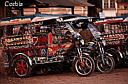
Vientiane is on the bank of the Mekong River at the border to Thailand. Vientiane has tuk tuks, like Thailand's but the drivers bust crank the engines to get them going - electric ignition is not on some of them yet. We took a Lao tuk tuk on a day tour out of town to the Friendship Bridge and other sites. The Friendship Bridge crosses the Mekong and was a joint project of Laos, Thailand and Australia. The notion is that this bridge will become an important link in a oad network that will eventually stretch from Singapore to Beijing. Although such networks should be beneficial to trade and economy for many countries, some people, especially in Laos, worry about consumerism, crime, prostitution, and environmental degradation that will be more readily spread. Nonetheless, when the Friendship Bridge was opened in 1994 thousands lined the banks, bands played, fireworks were lighted, and according to our tuk tuk driver, a spirit of optimism grabbed the Lao people that has not abated. People in Vientiane in particular see Laos as becoming another of Asia's economic tigers in the not-too-distant future. We weren't in any rural areas of the country, and were only in vientiane four days, so did not have enough time to hear enough opinions from a wide variety of people to get a feel for the realistic probability of early economic boom, or a feel for people's actual economic condition, or a feel for the formerly communist governments current treatment by the people. But it was clear the people are poor and live simply, maintaining a calm but hard-working life style at a pace perhaps aking to ours early in the century when most people did not have automobiles. Transactions take as long as it takes people to walk to accomplish whatever is necessary; deliveries are limited to the load size that can be carried on a trishaw, motorcycle sidecar or pushcart. Instead of the streetcars many of our cities used for public transportation people cram into two sizes of tuk tuk, maybe ten in the smaller one that would hold maybe six westerners, and maybe 14 in the large one that would hold eight or ten westerners.
I think one of my most abiding memories of Southeast Asia will be the various means of transportation. While we've been in SE Asia both Laos and Myanmar were admitted to the local economic support group ASEAN. (I think they postponed the admittance of Cambodia because of the current fighting, but I may well be wrong.) The few people we talked to and read of in the paper hope membership in ASEAN helps bring Laos into the modern age, but I hope the people can somehow maintain the pace, trust, and serenity of their current life.
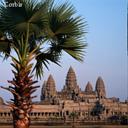
We visited a few temples in Vientiane, called wats, and learned something of the Khmer - style Buddhist temples. We had also seen a few Khmer - style temples in Thailand. This helps us not to feel bad that we can't see Angkor Wat in Cambodia.
On to the next journal
Back to journal index page
Back to map page
Back to alan's home page