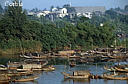
Houseboats on the Perfume River
August 7 - 16
The first afternoon in Hue I was really struck by the beautiful neighborhood we were in, right from the long riverbank park with little tables and chairs overlooking the water. I had a cold drink and watched children swimming in the river, sampans being poled downstream, men tossing cast nets for fish. On the street the passersby included bicycles with loads of bamboo, cycloes with passengers going places, cyclos with huge, heavy loads of 50 kilogram sacks of rice or ice or unidentifiable vegetables (yams or marnioc or some other root), individual cyclists and those with riders on front and / or rear fenders, and even a cyclo with a con strapped in the pasenger seat. Transport on these streets, as with those in Mandalay and less so in Vientiane, is almost an intimate happening. Everyone watches closely where everyone else is going, at what speed, and everyone makes way for everyone else. It doesn't really matter if you're on the appointed correct side of the street (in Vietman, the right) or not, because of all the paying attention. On top of all the eye contact, there is a lot of connection, sometimes even something like 'excuse me, I'm turning left here.' But mostly greetings, watching up on news, pointing things on the roadside out to each other, etc.
Moving along the streets, slowly, quietly, inches close to each other, seems an extension of the closeness we've seen in the neighborhoods and villages. People really know and care for their neighbors in the slow paced cities and villages we've visited during our trip. For example I think back to our time in Suliki, on Sumatra, in Indonesia, when we attended Yandra's wedding. When we got off the bus on the highway, and asked those standing on the road if they knew Yandra, they all said yes and pointed out the way, but some also ran on ahead to tell Yandra that westerners were here for the wedding. Then when Yandra and family came out to meet us, and Yandra explained that it was time for him to go pray now, it was neighbords who entertained us, introduced us to people and took us into their homes while we waited for whatever was to happen later in the day. They knew virtually everything about each other and were happy to describe people to us. As we walked the tiny village and we saw in what close proximity they lived, it became clear that they shared responsibilities and possessions with each other, helped each other as necessary, and were in truth, really good neighbors. As I mused on these things while sitting by the Perfume River in Hue and once again cherishing the slow, quiet, intimate neighborhood, I thought of a sadder sotry that made me realize the important role that is played by some things in our modern fast, high technology communities. When we were in Mandalay on a trishaw ride through the city streets, we saw a man in the forward-facing seat of a trishaw with the most anguished look on his face you can possibly imagine. In the rear-facing seat, a woman, apparently unconscious, had been laid across the seat. The anguished man, apparently her husband, was holding her in place as the trishaw driver pedaled for all he was worth. The intimate conversations in the street soon told us that the woman had fallen from the top floor of the four-story apartment building and landed on the dirt street below. But with no telephone and no medic one, the best the people could do was run ahead of the trishaw driver, shouting for people to make way, and pray they could get to help in time.
Thursday we took a cyclo tour of Hue in the morning. Hue had served as Vietnam's capital for about 150 years under the Nguyen emperors and had a splendid, walled imperial city from that time that was unfortunately mostly destroyed during the 'American' war. We saw the crumbling walls of the citadel, and actually stayed very close to the huge-based flag tower at one corner of the moat. Hue was the only city below the DMZ (and it's not very far below the DMZ) that was actually held by the north during war. Taking it back duringt he Tet offensive cost at least 10,000 lives. Today most of the area inside the citadel is bare, with grass growing with the tropical rains, very little home or business construction, and only a few areas tilled for gardens.
(At this point Mary Lou excerpted a section from Lonely Planet entitled HUE'. Please click here for the excerpt.)
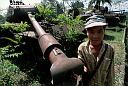
In the afternoon we went to the beach near the mouth of the Perfume River, Thuan An Beach. We had arranged the outing through a restaurant across the street from our hotel, nearby a family in which the parents and several of the children are deaf and do not have verbal speach. The daughter who helped us arrange a car, for $10 US, was 16, and her two younger sisters and hte sixteen-year old came on the beach afternoon, too. It was clearly a big, big deal for them, because when we met at the restaurant at the appointed time, the girls and others in the family were doing a bigg 'to the beach' song and dance that went on and on and on. I had been looking forward to an afternoon in the tropical sun that had faded a lot during the last few weeks of monsoon in the inland countries. (The weatherin central Vietnam was gloriously sunny and hot every day we were there, with afternoon rain only a couple of days.)
But when we got to the beach and I spread out on a mat in the sun, the girls crowded around and made shade, I think to protect me. I guess I haven't mentioned it yet, but the people in Vietnam prize a 'clear' complexion. 'Clear' doesn't mean free from blemishes, but means pale and unlined and moist; in other words, a complexion that has suffered no harm from the sun. Women everywhere wore conical straw hats with a wide spread, many cover their faces from nose to bottom of neck with a kerchief, and it is common to see over-the-elbow gloves covering the skin from finger tip to end of short sleeves. Of course kerchiefs and gloves cost money, so as with most cultural notions of beauty, it is the wealthy who can maintain clear complexions, not everyday poor. The standard everyday women's costume in vietnam is a pajama-like suit of matching shirt and trousers, made of a thin cotton print fabric, that shows the sillouette of the body when the sun shines. Silk and plain, close-weave fabrics are more expensive, so again it's the wealthy who are most fashionable but to me it looks like the poor are the most comfortable.
We actually had a splendid time at Thaun An beach that afternoon. We swam and hopped waves in the calm surf and tried to body surf but they petered out before they got to shore. bob played with the littlest girl in the water and she had a ball. I finally made the kids understand I really wante the sun to shine on me and read for a while in peace. It was a wonderful brightening after a few weeks of inland monsoon.
Friday we took a river cruise on the Perfume River with a few other travelers. It was an all-day affair, again arranged by the restaurant run by the friendly family. Motorbikes picked us up at 8 o'clock and took us to the boat landing on the other side of the river. Our launch was about the size of this one (picture), but brightly painted as a tourist boat with a great dragon on the bow. We glided quietly through the city - not silently; we had a long tail engine - into the country side where we were treated to sights of people making their livings in unusual ways on the river. Some dove to the bottom and brought up basketfuls of silt to help keep the river clear. The silt must have been sold for some purpose for many sampans overloaded with silt made their way toward town. Some donned face masks and dove along the shore to pick a certain vegetation. Maybe it was a fresh water 'seaweed', but whatever it was, it was loaded on sampans and taken to town for sale. In a couple of places dredging barges had conveyer belts bringing up rocks and silt, and people's sampans hauled the rocks off somewhere to sell, I suppose. If it's possible ot get the essential ingredients for paving from the bottom of the river, maybe it's better to do that than dig big gravel pits out of the foothills. But I don't know what the fish think of all this going on. Of course, small boats moved along the river, too, simply using the world's oldest highway as transportation, fishers fished, water buffaloes swam, and women laundered.
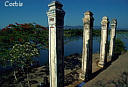
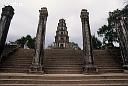
The river trip took us to the sites of several of the tombs of the Nguyen emperors. We went into some of them, picking and hooseing by the guide book. Sometimes we had to hire motorbikes to take us from the landing to the tomb, and one time a substitute return driver absconded with the round trip price, leaving the initial driver with none, until Bob finally convinced him he had to get his money from the other guy. Competition seems to have become unfriendly at that location. Each 'tomb' actually consisted of acerage of gardens, temples and art galleries as well as celebration halls used duringt he emperors' lives. The Hanoi government, like the Burmese, imposes an entrance fea on the foreigners but not locals, so once again I found myself wishing for an Asian face. but one time I avoided the fee by climbing a footpath up the hill alongside the garden wall and taking pictures through the many gaps in the wall. I thought of all the money and labor used to prepare these tombs for the kings, like those for kings in numerous other cultures, and am glad we don't have such a tradition. But we spend vast sums on presidential libraries, don't we?
I think many of the infulential people and ideas in my life need that same freedom.
On to the next journal
Back to journal index page
Back to map page
Back to alan's home page