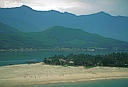
Lang Co Village
August 9
On Saturday, August 9, we took a bus to Lang Co, a beach maybe 25 km south of Hue, where we spent a few days just enjoying the weather and water. Lang Co is an island facing the ocean on one side and a large lagoon on the other. the lagoon looked inviting, but the day we hired a motorbike to go over there, I found the swimming was not too pleasant. The view was splendid from the hill above the lagoon, though, and I hope photos turn out so you can see the island and its setting well. The photo here makes the beach on the ocean-side look less inviting than it really is. Not many folks stay at the one hotel, but every day tour groups stop for an hour or two and lunch, so the beach is plenty populated. Sellers galore also populate this spot, mostly teenage girls but also some moms and here competition is friendly. I bought a figurine from a mom for 17,000 dong (10,000 dong to a dollar) and a couple of days later wanted to by a similar one - same style, different pose - from a girl. I told her her price was too high and offerent 15,000, "the price I paid the other day". She quickly described the woman from whom I'd bought the previous figurine and said she'd told her I paid 17,000. So I was caught with my foot in it and poneyed up the 17,000. I never tried that trick again.
The only beach problem in Lang Co was that the sellers would park in the sand around you and sit silently, or chat among themselves for hours. One day we figured out how to get some privacy. I really wanted it, too, because one kibitzer was definitely throwing me off my domino game, chuckling at every move I made. I said if they would all go sit somewhere else I would call them when I was ready to pay 40,000 for a beer, and they'd get the profit. Worked like a charm, and from that moment all I had to do was raise my arm and two beers with ice (the only way to get them cold) were delivered instantly. It was a great afternoon.
A highligh of our time in Lang Co was our invitation to have dinner at the home of a local teacher. On our last night, he picked us up in sequence on his motorbike and brough us to his small house down the island about 1 1/2 km. When I arrived his wife and daughters were removing stems from some leafy vegetable so I squatted down and asked if I could help. I watched carefully, but never quite thought I did it right. Some stems were to remain, apparently, and some leaves were to be separated cleanly from the stem, but I couldn't figure out the deciding points, and of couse we shared no verbal language. But when Bob and our host arrived and found me 'helping' the host was delighted and the wife and daughters were accepting my contribution in good humor. Once again, however, the family wouldn't eat with us and we were served in the living room with the husband. He's a high school teacher on the island, and does his best to be sure his studenst learn. Several have no parents, and live with friends or grandparents, so he helps buy school supplies for them. We contributed, of course, but went home with the nagging feeling that he may have been running a scam. Nonetheless, we enjoyed our evening in a Vietnamese home and I especially delighted in the time fixing vegetables with the wife and daughters. We had not had the opportunity to be in a person's home in Laos, as we had had in Burma, Malaysia, and Indonesia, and I was happy to be invited again in Vietnam. Our host also demonstrated the closeness of village and neighborhood I wrote about earlier. A man a little older than I, a war veteran, came over while we were chatting in front of the house, and wanted to visit with Bob and me. He had a little English, but he was drunk, and didn't keep track very well. Our host tolerated his presence for 40 minutes or so, then walked him home. He said he comes over every evening, feeling lonely, and our host family does what they can forhim.
Tuesday we took a bus to Danang. The plan was to stay in town one night then head down to China Beach for the rest of the week. I guess I haven't explained the Vietnamese hotel system. When you check in, you must leave your passport and departure card with reception. Reception must register your presence with the police. When we arrived in Danang, however, Bob realized he hadn't picked up our passports when he paid the bill at the hotel at Lang Co, so we couldn't check into another hotel. We found a shop that let us make a long distance phone call, for a hefty fee, and Bob and the Lang Co hotel decided he would go back to Lang Co by taxi to pick up the passports. I parked in a nearby watering hole and two hours and US$35 later Bob was back with the passports in hand. He had dumped the taxi and rounded up two cyclo drivers to find me and take us to accomodations for the night. We put in at Dai A Hotel and arranged for the drivers to take us to the market then to China Beach the next morning. Just around the corner from Dai A Hotel was the dandiest Pho' shop you can imagine. It seems a bit strange to say that the soup in that shop was so great because it was just like that at home, but it most certainly was. I guess the complimaent there is for the restaurants at home, that have been able to maintain their authenticity to the Vietnamese original.We ate pho' for supper and pho' for breakfast and paid a pittance in total, then hit the silent road toward My Khe beach. My Khe beach is a skip and a hop out of Danang (but much more difficult than that for our poor cyclo drivers) and is thought by many to be the 'real' China Beach of war-time fame. Whichever the case may be, we chose My Khe beach because we hoped to get some body surfing in, but unfortunately the surf was never up to the way it had been on Lankaui in northwest Malaysia.
One day we took cyclos to the beach named China Beach, but we didn't actually see how the surf was because I was unwilling to pay an entrance fee just to go to the blinking public beach! [never go to Florida -alan] Avoiding the China Beach government hotel was also a good reason to choose to stay at My Khe beach.
(Excerpts:)
 My Khe Beach (Bai Tam My Khe) is about six km by road from central Danang. the beach is said to have a dangerous undertow, especially in winter. However, dangerous conditions often go hand-in-hand with large breakers which look ideal for surfing, assuming you know what your're doing. the surf can be very good from around October to December, particularly in the morning when wind conditions are right. With this in mind, the Danang Surfer's Club was born in 1992. The club was founded by vietnamese who hang out at a stall called Club Kola next to the big stone gates at My Khe Beach. Board rentals are avialable, but you should bring some wax and a ding repair kit since neither can be purchased locally. Many people insit that My Khe was the real China Beach of wartime fame and the present 'China Beach' is a fake. |  China Beach, made famous in the American TV serial of the same name, stretches for many kilometres north and south of the Marble Mountain. During the Vietnam War, American soldiers were airlifted here for 'rest and recreation', often including a picnic on the beach. For som, it was their last meal because they were soon returned by helicopter to combat. Many have insisted that this isn't the real China Beach at all. The place most popular with American soldiers during the war was My Khe Beach five km to the north. The motive behind naming the current beach 'China Beach' seems to be to capitalise on the famous name so as to draw foreign tourists to go to the government-owned China Beach Hotel. Near the hotel, private vendors flog China Beach baseball caps, wooden carvings of Buddha, jade bracelets, new antiques and other tourist paraphernalia. Perhaps of its famous name, in December 1992 China Beach was the site of the first international surfing competition to be held in Vietnam. |
It was fun to hang out on My Khe beach. It didn't take much to get the sellers to park somewhere more than ten meters away - a couple of glares did it - and yet if you wanted a great plate of steamed snails or rice crackers and chili sauce they were at the ready. We had a really good time just relishing the almost last bit of this splendid holiday, Friday our cyclo drivers took us on motorbikes to the Hoi An, a city south of Danang almost as beautiful as Hue'. Unfortunately, Hoi An was absolutely teeming with westerners and the people were really tuned in to snagging the westerners for whatever they could get. I totally disagreed with the impression we were given by the articles in our 1996 guidebook:
Hoi An
Danang
Hoi An is a riverside town 30 km south of Danang. Known as Faifo to early Western traders, it was one of South-East Asia's major international ports during the 17th, 18th, and 19th centuries. In its heyday, Hoi An, a contemporary off Macau and Malacca, was an important port of call for Dutch, Portuguese, Chinese, Japanese and other trading vessels. Vietnamese ships and sailors based in Hoi An sailed to Thailand and Indonesia as well as to all sections of Vietnam. Today, parts of Hoi An look exactly as they did a century and a half ago. More than perhaps any other place in Vietnam, Hoi An retains the feel of centuries past, making it the sort of place that grows on you the more you explore it.
Back in the heady days of the Vietnam War, Danang was often referred to as the 'Saigon of the north'. This cliche held a note of both praise and condemnation - like it's big sister to the south. Danang was notable for it's booming economy, fine restaurants, busy traffic and glittering shops. 'Entertaining the military' was also a profitable business - bars and prostitutes were major service industries. As in Saigon, corruption also ran rampant. Liberation arrived in 1975, probptly putting a sizeable dent in the nightlife. However, Vietnam's recent economic liberalisation has helped Danangg regain some of its former glory - and all of its vices.
Warning
Just as it's hard to believe that Hoi An can be so good, it's hard to believe that Danang can be so bad. Danang gets the thumbs down from just about everybody. There are several reasons for this, not the least of them being the attitude of the local police. Vehicles seen carrying foreigners are stopped by the police and the occupants 'fined.'
The attitude in Hoi An seemed to be 'this is an outstanding place, so it's okay for us to demand a lot of you foreigners.' We were stopped outside several places we were looking at and asked for our entrance fee receipts. We explained we had no intention of 'entering', but the people (city tourist officers? police officers?) shooed us away anyway. We seemed to need to pay entrance fees to stand on the city streets and look at the exterior of a temple or museum. In Danang we had no comparable experiences, nor did we in Hue, and we experienced no unfriendliness on the part of local people. But outside Hoi An a little bit of the afternoon rain hit, and our drivers pulled into a little drinks stand in front of a house, where we sat under a roof and had a cold drink while waiting for the rain to pass. The woman owner could have been very pleased if we had not been foreigners; she glared at us, served us with reluctant snorts, and wanted to charge us a fortune, until one of the drivers said he was paying and she quoted him the correct price. But walking by the river in Hoi An was very pleasant, and the town truly was lovely to look at, so I'm glad we went.

We did miss one thing in Hoi An I had wished we could see, but the timing just would not work out. We had read in the guide book about the dragon boat festivals held in some southeast Asian coutnries, and had actually seen a crew practicing on the Mekong river outside Vientiane, while we were in Laos. Crews of 56 men row long, narrow boats at amazing speeds as the centerpiece of a two-day festival designed to gather and destroy evil spirits. The rousting-out of the evil spirits begins on the day before the boat races:
(excerpt:)
Long Chu Dragon Boat festival
Hoi An, Quang Nam province
The day before, seven elders lead a procession of young men around the village, seeking the pace where the most evil spirits live. Once found, incantations are made to try and exorcise the spirits. At home, families do the same thing. The boat is then carried to the temple, and the leader of the elders paints two eyes on the prow of the boat. From midnight, people begin to file into the temple to pray, and inform the dragon boat of their plans. From 5 to 7 am, people burn incense and make offerings to their ancestors; between 7 and 9 the dragon boat is carried to the gate of temple; then at 9, the priest prays as young men carry the boat around the village ahead of a procession. In their homes, people try to kill the evil spirits by waving mulberry branches around, these are then thrown into the dragon boat. Once the rounds are done, the loaded boat returns to the spot identified the previous day, and at about 9 pm is ceremoniously ignited.
August 17(15th day of the 7th lunar month)
Unfortunately, since we wanted to be in Hong Kong so I could go to the office on Monday, Aug 18, and we couldn't make the appropriate flight connection Sunday afternoon, the 17th, we had to leave Vietnam on Saturday the 16th and we couldn't stay for the boat races on the 17th.
However, we had stayed to watch in Vientiane. Our tuk tuk driver had taken us out to Friendship Bridge, and on the way back I noticed what I thought was a crew boat whizzing along the Mekong. We stopped and walked back to a cold drink stand in front of a house on the river side of the road. The driver asked the owner if he had seen the boat - he had - and said it should be back in five minutes or so. We drank and waited, and sureenough, a few minutes later the boat came back, making unbelievable speed upriver. Our host said they practiced 4-5 hours a day and now were doing especially well because there were races coming up in a couple of weeks. So now knowing what we have learned about the timing of the races in Hoi An, Vietnam, I assume that timing was similar in Laos. It would have been fun to see the full-dress finale, but watching those hard-working young men in the Mekong may have given us a fuller appreciation of the effort involved.
So Saturday, August 16, we reluctantly boarded our loyal drivers' cyclos one last time for the ride from My Khe beach to Danang Airport, knowing we had truly finished our adventure in the developing countries of southeast Asia. In a few hours we will be in Hong Kong, a 'special administrative region of China' by now, no longer a British colony, but still a modern blend of cultures perhaps more west than east and certainly a territory decades ahead of those we've been in for the last few months. Having written that, I'm not sure what I mean by 'decades ahead', but I think I mean something having to do with the loss or lessening of intrinsic culture common to many countries and communities as the world shrinks with technological changes in transportation and communication; and a sheen of sameness so many countries and communities share now, toward the end of the twentieth century CE. But if a territory is 'ahead' in this 'loss or lessening', is that an advance? When I think of the openness of people's homes, the rituals we shared, the intimacy of the streets, the reliance on neighbors and community, I know it's a major loss. But when I remember the neighborhood in Mandalay, the trishaw driver trying his best to help and the anguished husband and injured, or dead, wife, I know 'modernization' is not all bad. I am in more of a quandry than I am comforted as we arrive in Hong Kong.
Mary Lou Maag, August 16 1997, Hong Kong

Back to journal index page
Back to map page
Back to alan's home page