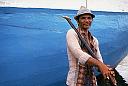
Ferry Boatman
May 28 - June 1
Wednesday morning we reboarded the dandy craft for the crossing back to Manado, this time sharing the available space with a load of copra-hunks of sour coconut meat in huge, heavy, fragrant bags. They took up so much space on the floor that we sat on the gunwales and put our feet on the benches that were partly covered by bags. The bags were piled on the beach and lifted - one by one - two people to do the lifting - onto the shoulder of our slight boat driver, and he carried them to the boat and passed them off to two more people who loaded them onto the boat. That slight driver was amazingly strong!
We wandered around Manado for a time before flying to Jakarta, where we arrived on the eve of the national election. Because the campaign season had prompted violence at several rallies throughout the 27 days, and in fact many died in the confrontations, the other travelers at Bastiano Cottages had expressed concern that our routing caused us to stay in Jakarta the night before the election. But campaigning had officially ended the previous weekend, leaving a quiet bit before the actual voting, and we weren't going into town at any rate, just staying near the airport to catch our morning transfer flight, so we figured we'd have no problem, and in fact we did not. We saw only a tiny portion of the huge city (Singapore is smaller than Jakarta), but from what little we saw, we understood all we'd read and heard. Jakarta has been called The Big Durian - Durian is a huge fruit with a reportedly wonderful taste but highly controversial odor, but some say it's not now so bad; we should have seen and smelled Jakarta 20 years ago. As it was, we were glad to stay only a few hours. Jakarta is a typical large city in developing countries; poor people move to the city by the thousands each day looking for work, but find no jobs and live in sad squalor just getting by in the informal economy.
Excerpt:
Although Indonesia is better off than it was 20 years ago, the fruits of this economic growth are very unevenly distributed. Yet somehow even the poorest of Indonesians show a remarkable resilience and capacity to survive. They sell food, clothing, plastic shows, sit on the site of the street all day flogging off a few combs or a couple of bunches of bananas, jump on crowded buses to hawk ice blocks, pineapple chunks, or single cigarettes. They sift through garbage, recycle the tobacco from cigarette ends, pedal becaks (trishaws), shine shoes, mind parked cars, or scratch some of the money from the tourist industry as touts. And if they come home with nothing then their family or neighbours will help them to survive another day.
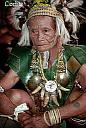
Thursday morning we flew to Balikpapan, on the southeast coast of Borneo, in the Indonesian state of Kalimantan. It was election day, and a great day to fly since most people were staying home to vote (if you were not in your hometown by Thursday to vote, you may not be able to vote, since the ease of our absentee ballot system has not yet reached Indonesia. Bus and plane travel was crammed on Wednesday but Thursday conveyances were almost empty and Jakarta airport seemed deserted.) Our intention in going to Kalimantan was to either visit the people who live in villages upriver in the interior or visit Camp Leakey, an orangutan rehabilitation center in Central Kalimantan that we read about. Unfortunately, because of limited time and money, we did neither; and contented ourselves with a brief look around industrial but pleasant Balikpapan and a rushed one-day car trip to the nearest, most westernized orang gunung village. (Orang gunung means mountain people; orang utan means forest people, a considerably different species.) Orang gunung are also called Dyaks, but Dyak is a slightly pejorative term. The orang gunung traditionally live in communal longhouses one room deep and up to 300 metres long. The longhouses are built on stilts as protection against wild animals, flooding, and in the past, enemies. Logs notched to form stairs lead up to the house and can be pulled up as needed. We saw one longhouse, only about 30 metres long, and only used for community meetings and gatherings, but not lived in. The old custom was for orang gunang to largely pierce their earlobes; if women, numerous gold rings were inserted, stretching the lobes into what is now called longears; if men, leopard or boards teeth were inserted. It was also the custom for some men, and all women, to cover their arms and legs with intricate tattoo designs. We met a few people who exhibited these old customs. They were very kind, but clearly made their livelihood by meeting, and posing with, travelers such as ourselves. One 70 year old man, had the most beautiful laughing face, but wanted to be somber for his photo. I'll remember his eyes forever, though.
Excerpt:
Many Dayaks are modifying their traditions under pressure from the Indonesian government and European missionaries. Neither the Muslims nor the Christians seem content to leave the indigenous belief systems, the backbone of these tribal cultures, alone.
I actually enjoyed Balikpapan. No cheap accommodations exist outside the rooms-by-the-hour district in this wealthy oil, coal and lumber town, so we took a room for 50,000 RP in a bayside hotel with a terrace overlooking the water. Actually, the terrace was over the water and a strong breeze from the water cooled the town all day, and afternoon tea on the terrace was great. The town was cleaner than many and people were friendly and not trying to sell you something every moment (which we only experienced in Bali). We found some dandy warungs(?) and ate great grub cheap. Wild and remote it was not, but we had a pleasant time.
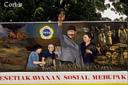
The day after, the election results started to be broadcast. The government had decided that the election results would not be made public, and would not be disclosed to the candidates, ie., the parties Golkan, PPP, PDI, until the day after the election. The election committee and the government (read Golkan) received the results on the evening of election day, as they came in, but PDI and PPP were not to be notified. When I read that in the paper I thought it would be easy to rig an election under those rules. Lonely Planet says corruption is one static, permanent feature of the Indonesian economy.
"High-placed government officials, and their families, routinely become quite wealthy during their terms in office." During the campaign weeks many people we talked to expressed the same thought when the election results were finally announced, Golkan had won over 73% of the vote, more than in the last election five years ago. The troubled and divided PDI barely managed 3%, and PPP got around 24%. In Jakarta the Golkan/PPP vote was almost evenly divided, and in some places on Java PPP actually came out ahead. People we talked to were pleased with this aspect of PPP's showing. But we left Kalimantan, and Indonesia, two days after the election, and have not yet found commentary on the election results in non-Indonesian papers, so the aftermath seems anticlimactic after our intriguing brush with the campaign.
[At this point, Mary Lou (Mom) excerpted a large portion from the Lonely Planet guidebook regarding the Golkan leader, Suharto, and other political issues in Indonesia. The excerpt, from an article entitled 'Facts about the Country', written in 1992, can be found here. -alan]
Our transport from Kalimantan on Borneo, to Sabah, East Malaysia, also on Borneo, was to have been a one-day combination of plane and boat rides that turned into a five-day affair. We wanted to fly directly from Balikpapan to Sandakan, in eastern Sabah, but had to fly to Tarakan, Kalimantan, then take a boat to Nunukan, Kalimantan, where we had to stay over night before the next boat to Tawa, Sabah. Actually, Nunukan was a pleasant tiny town, where, at the little restaurant where we had a delicious prawn dinner cheap, we each were bold enough to take the karaoke microphone for a couple of songs. We were the only customers, so they were playing English songs of the 50s and 60s. Actually, when I was in Manila in 1973, they were playing English songs of the 50s and 60s. No change at all. We got a kick out of it but it was probably a one-time experience.
In Tawa we put in at the recommended Hotel Soon Yee, since we couldn't get a flight to Sandakan 'til the following morning. Unfortunately, in the morning while I was down the hall having my maudi, someone came into the room (door was ajar so I didn't have to take key or wake Bob when I came back) and took my wallet from the desk. That whole day and the next day was a series of visits to police offices and immigration offices and phone calls to the visa credit card and traveler's check people in the USA. The owner of the hotel, Joseph ___, ferried us around in his teeny car, paid scads of parking fees, and made sure we were well taken care of. He also moved us to a room with it's own bathroom for no additional charge. The travelers checks, credit card and passport were all replaced, or in the process of being replaced, by the time we flew up to Sandakan Thursday morning. We figure the US$500+ and Ringgit 100+ is our contribution to the informal Malay/Indonesian/Philippine economy that is strong in Sabah. Wonder if we can take a charitable contribution deduction...
The goal in Sandakan is to see wildlife, including the orangutan. Due to lack of time and money we were unable to visit the remote Camp Leakey in Central Kalimantan that we read about. Birute' Galdikas wrote a wonderful book, Reflections of Eden, that Bob and I really enjoyed on this trip. Galdikas is one of the great ape studiers sponsored by Louis Leakey, along with Dian Fossey, gorillas, and Jane Goodall, chimpanzees, who has been studying the Borneo orangutan for over 20 years. I attach Galdikas's summary of her book here. If nothing else, have a look at the thought provoking finale beginning on p.401
On to the next journal
Back to journal index page
Back to map page
Back to alan's home page