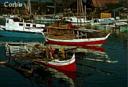
Harbor of Ujung Pandang
May 17 - 21
When we arrived back in Sentani Saturday afternoon, we learned we'd have to stay there two nights because there were no flights to Yung Pandang, on Sulawesi, on Sundays. We took advantage of the time to use the fancy washing machine at the Semeru Hotel. First you turn the switch to close the drain on the tiny wash tub, then fill a few buckets with cold water from the nearby hose. Dump these into the tub, with clothes and soap, and flip a switch. The tub sloshes the clothes about, first one direction, pause, then the other, for ten or fifteen minutes, then stops. You open the drain, recover the clothes, then rinse them under the hose in buckets. You wring them out manually then pile them in the machine's even tinier spin tub and turn it on. It draws water from the clothes for twenty minutes or so, then you can hang them on the line. It's almost as time consuming as washing them entirely by hand, but somehow seems very much easier, I think, because you're not bent over as much. I hope we come to another one we can use somewhere along the line.
As we were taking off from Sentani Airport Monday, on our way to Ujung Pandang on the island of Sulawesi (formerly Celebes), I realized we'd left the camera in the hotel room in Sentani. I was so disgusted, and it was so apparent, that a flight attendant came to see if I was well. I explained, and another flight attendant took all the necessary information and said he'd see what he could do. When we stopped at Brak, and island in northwest Irian Jaya, I was escorted off the plane, across the runway, to a small Garuda office where people telephoned the hotel in Sentani and other airport offices to make arrangements for the thing to be stuck on another plane to Ujung Pandang. It arrived a few hours after we did, handed to Bob with big smiles. I was amazed and delighted that the hotel, airport, and airline personnel on three different islands would put themselves out at no expense to us for our own foolish mistake. An excellent show of humanity.
Sulawesi is a multifingered island; Ujung Pandang is the largest city on the southwest peninsula. After collecting the camera, we walked ten minutes to the lodgings nearest the airport, Afriat Hotel, to spend the night before our flight to the interior the next day. (Although convenient, I didn't think the place was a good value for it's high price, but that was probably because I had a bit of a fever and was uncomfortable anyway. That's the only touch of illness we've had, not even any diarrhea to date.)
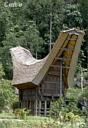
The Toraja people and their traditional houses and burial customs are the draws to southwest Sulawesi. Tuesday we flew north to the TanaToraja area; the main cities are Santepao and Makale. The Tonaja people continue to predominately make their livings by farming or raising livestock. The old religions were basically replaced by Christianity about a hundred years ago, but many of the old traditions still remain.
As in other parts of Indonesia, the architecture of the traditional Toreja houses distinctive. In this case, the story is that the people originally came from Indo-China in boats, and when they arrived they needed a place to stay, so they brought their boats ashore and stayed in them. Now traditional houses are made with roofs in the shape of boats, which are reminiscent of the West Sumatran Minangkumbau roofs in sweep, but not in detail. The houses are build up on stilts, some say against the crocodiles that sometimes come out of the rivers, but others say it's to keep the wood of the main house dry for longevity. the multi-layered bamboo roofs last fifty years, we're told! Only high caste Torajans now live in traditional houses because of both expense and tradition, but the majority of people of all castes now live in modern, Java-style brick and stucco houses with corrugated metal roofs. A traditional Toraja village has houses that all face north, toward the ancestral land, and that each have a number of rice barns across the road from the main house. In addition to space for rice storage, the rice barns provide a welcoming space for guests. The platform part way up the barn's stilts is used for guests to gather on and be served beverages before being invited into the main house. the guide who took us through Tana Toraja, Roby, said when he goes home to his parent's house he is pleased to be still sleeping in a traditional Toraja home.
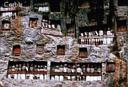
Prior to the arrival of Christianity, the Toraja people believed that the soul of the deceased would ride the souls of slaughtered buffaloes and pigs to the afterworld. So depending on the age and wealth of a person, between one and twenty four or more buffaloes must be slaughtered for the funeral, which maybe held as long as a year or more after death, during which time money is saved and preparations are finally made when the funeral can be afforded. A family grave is hewn in the rock cliff, and if the deceased is of high status, a wooden effigy, called a tau-tau, is placed in a niche in the cliff by the grave. Even though the people are now mostly Christian, the funeral animal sacrifices and ceremonies continue, but almost no new tau-tau are used. Now a family mausoleum, a small building, is built, usually with a large cross on the wall, but on the roof sits a replica of a traditional Toraja house that has always been, and still is, used to carry the deceased to the grave. Other old Toraja customs we saw included the burying of infants in carved out niches in certain trees. Infants before teething age were thought unable to make it to the afterworld unless they grew older, so they were entombed in the trunks of fast growing trees so they could grow with the tree, and thus make it to paradise.
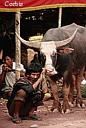
In Pantepao we went to the huge weekly market, which includes a livestock market. The biggest water buffaloes we've seen, by far, were walked in from villages two or three days away to see what they would bring on the market. We were told the black ones were thought to be the strongest, but the black and white mixed colored would probably bring the best price - their coloring making them more special, and the albinos - a few were present - would bring not very much. Size was some consideration, but color seemed much more important. Pigs, too, were for sale, but a sad sight to see. Their front legs were tied together and their back, then the four were drawn together and tied. Cords went from the feet across the poor animal's backs, and were tied to a carrying handle. Smaller pigs were tied two together into one carrying handle. They were laid out on their sides on concrete slabs, thankfully shaded, for prospective buyers to view, soiling themselves and each other by lying there all day. I have no idea how pigs are bought, sold, or treated at home, but these poor animals seemed to be suffering. The chickens weren't much better off, maybe worse. Four or five of them had their feet all tied together and they were lying on the ground in squaking, writhing groups.
The most colorful part of the market, as always, was the fruit and vegetable section and it's multicolored plastic shading, hung as always for folks shorter than us Scandinavians. But I was intrigued by the palm wine, tuak. Palm trees are tapped near an offshooting branch, the liquid is collected in a bamboo tube, and certain sugars and spices are added. It is brought to market in the morning, when it is not very fermented, and sold in bamboo tubes about four feet long. In the morning the tuak is still too sweet, so people add pine bark to it (also sold at the market) to make it more bitter. Purchasers later in the day don't need to add the bark, because it is fermented enough. Four feet of tuak seemed a lot, so we didn't try it. But later in the day we saw some trees being tapped for tuak, so that was fun.
May 21 - 27
While touring Tana Toraja, we saw our second PDI demonstration. PDI is the people's democratic party, the red one, that uses the three fingered sign for the buffalo. Roby, our guide for our day tour, said he was part of the red party since buffaloes were so important in the Tana Toraja. But others I talked to in this area discussed the twenty-plus year rule of the Golkan party and Suhuato, who is now 77, and expressed a strong desire for change. The government is too corrupt, they said, and too strongly pushing Islamic ways. Most Torajans are Christian with an old culture of animism, and it's easy to see why a push to a different religion and the customs that entails would be unpleasant. The demonstration was a vehicle convoy, hundreds of motorcycles, many open trucks crammed with redshirted followers, and bemos with red streamers flowing from their antennas, all participants shouting, and waving the hand signal. It actually looked like fun, in a mass hysteria sort of way. No speech making here, but there would be at the rally at the end of the convoy. Many people were originally PDI supporters when Meganasi, daughter of Indonesia's first president Sukarno, was the active leader. But Golkan pushed her out of the public eye by forcing her out of the political arena entirely (I don't know how; it was a year or two ago), so there was a split in the party and many people are jumping to PPP, the united development party, an Islamic opposition to Golkan. We hadn't yet seen anything of PPP, but when we returned to Ujung Pandang Thursday, 5/22, the PPP was convoying down the street in front of our hotel, all the same hooting hollering, hand signing and singing, as with Golka and PDI, but this time the color was green and the motorcycle riders were repeatedly revving their engines in a brisk rhythmic beat. Although I suspect it makes little difference to some of the participants in these campaign events, I wish I understood more what the issues were.
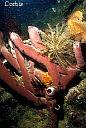
Friday morning we flew from Ujun Pandang to Manado in north Sulawesi, heading for some relaxing beaching (which gives the impression what we've been doing is not relaxing, entirely untrue). According to folks we've talked to, off the shore of Manado, Bunaken Island has snorkeling as good as Australia's Great Barrier Reef, some of the absolute best in the world. We've only snorkeled once, several years ago in Hawaii, but it was beautiful and fun. We arrived in Manado and took a taxi straight from the airport to the public boat dock to catch an outrigger to Palau Bunaken. As usual with Indonesian public transportation, we needed to wait until the conveyance was full before leaving the port, giving us plenty of time to view our surroundings. The cab had left us off in a bustling market on the edge of a river (as many seem to be), and the river's mouth was lined with concrete retaining walls with narrow steps going down to water level. The walls and steps were not in good repair, se we'd made our way gingerly down to the boat. Our boat was about 30' long, 8' wide with benches lengthwise along each side of the hull. the bow was covered with some boards so people could sit there, but the largest part of the boat had a wooden roof, providing welcome shade. The luggage - backpacks, shopping bags, fruit and chickens - was piled on the floor between our feet and spare people sat on the luggage and the roof so the trip would be profit making. When we shoved off - poled off - for the 45 minute crossing to Bunaken, we found that our craft was satisfactorily sound, with bamboo poles fitted as outriggers for balancing the moving passengers and shifting cargo, both outboard engines functioning most of the time, and persistent bailing. We disembarked on a fairly small beach on small Bunaken Island, and I checked out the [something cut off here - alan] places available along the beach. We selected Bastiano's Cottages, probably illegally built directly on the comparatively narrow beachfront, but irresistible. Bastiano's was a group of separate little bamboo and wood cottages with attached outdoor maudis, broad verandah and only a few steps. Some of the other homestays had the cottages high up the hill above the beach, some a couple rough flights of stairs to w.c. and maudi (yucchy at night!). So we stayed in the cottages on the sand, where the waves lapped at our steps at high tide. We ate with the other travelers in the open air dining room three times a day and snorkeled for four days straight before we'd had our fill - for a while. The first day we took a small outrigger with four others and snorkeled all around our island and two neighboring islands, all three included in the national park and sanctuary encompassing this special area. Close to shore everywhere here is glorious coral reef of colorful hard and soft coral - I didn't know there was such a thing as soft coral and it's amazing! - and what we understand is the widest variety of species of fish almost anywhere. With the sun shining on the fishes and reef walls, and everything we saw more colorful than could be imagined, we felt as if we were surrounded by heaven. I also felt as if I was neglecting my self-appointed task, to learn from other peoples but decided other forms of life offered learning, too. Unfortunately, in the five days I learned little more than the names of a handful of fish. But, my goodness we had a wonderful time. Bob pronounced the place an absolute tropical paradise.
We visited with the few other travelers at our place and places nearby on the beach, from Switzerland, Germany, Denmark, Australia and one other from the USA, and added our names to those protesting the jet ski damage being done to the Bunaken reefs; we were awakened by six jet skis zooming across the reef in shallow water at 5 am Sunday morning. Incongruously, the jet skis were sponsored by the owners of a nearby snorkeling and scubadiving shop, folks you would think would be concerned about caring for the reefs and fish. It was good to get to know folks as this issue was processed for rescutation(?) to the Indonesian government. The man who actually met with the officials in Manado was given a letter of commendation and an award for his efforts. All in all, it was a splendid time. We snorkeled right out in front of our cabin as well as taking boat trips. We're now noticing in the guide books when they mention snorkeling and maybe able to include some more in this trip.
On to the next journal
Back to journal index page
Back to map page
Back to alan's home page