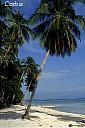
Adoki Beach, near Sentani, Irian Jaya
May 15th
Wednesday at 6 am we checked in at the Sentani Airport for the hop to Wamena. On arrival a throng of potential guides clung to the fence outside the airport boundaries. When we emerged the one who stuck to us was Ishak Gemungga, given his biblical name by his pastor father. We inquired about the guide Moorca recommended, Ebanus, who was already out on a trek. So we made arrangements with Ishak to guide us to villages in the south Baliem Valley, said to be more traditional than those in the north with a stronger missionary presence, then back up to Wamena for a night, then to a central village named Iiwika. In each case, we'll take the easy way by bemo most of the way. Then short walks to the village where Bob can stay while I go with Ishak on a hike to more remote villages.
Wamena is a very small town but not a village, with considerable bemo traffic. It's easy to walk all the blocks, which Bob and I have done a few times in just one day. Yesterday we found a Minang restaurant with Padang food that felt like home to us! The market is bustling with people from Wamena and nearby villages but includes people dressed in traditional costume (gourds, feathers) who are present only to grab you and charge a fee for the privilege of taking a photo. The women who come to make their market purchases load large string bags they carry by putting the handles on their heads, and the load down their backs. This contrasts with the large woven baskets women filled and carried on their heads in Bali, and the plastic tubs and gunny sacks carried on heads in West Sumatra. In Wamena, women also carry bundles of wood on their heads, and we saw one woman, in fact, carrying half a dozen 15' unsurfaced 2x4s on her head!
I find writing sporadic and interspersed between wandering and taking pictures, beaching, and fending off hawkers (but not in mountainous Irian Jaya), visiting with the local folks practicing English and with other travelers, and of course reading. Bob and I both loved A Civil Action but unfortunately did not make a note of the author before trading it away. It's the story of a lawsuit against WR Grace and others regarding chemical dumping causing leukemia. Extremely well written. I also absolutely loved White Man's Grave, by Richard Dooling, a novel about a young man who went to Sierra Leone in the Peace Corps, went missing, and was sought by his US friend and father. Excellent plot with twists and turns and a surprise ending, plus learning about customs in Sierre Leone from the US author who lived there for a time.
This morning Ishak keeps popping in and depositing food in our room in the losmen, so we'll be on our way soon.
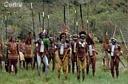
Bob, Ishak, six others and I took a bemo from Wamena to Kurima, a highland village very recently accessible only by foot but now connected to the main valley road by a new bridge. On the way at a not-so-new bridge, the procedure was for passengers to walk across and the van to drive slowly on it's own. It happened to be an excellent day to arrive in Kurima. Golkan Karta, the Golkan Party, was sponsoring a political rally, so the platform was set up festooned with yellow banners and yellow flags and clothing were everywhere. We came to see traditional culture, so at first I thought the Indonesian political rally was a bad thing for us, but it actually served as a draw to bring the people from many villages, some a few days' walk away, into Kurima. The people dressed in their traditional feathers, grasses, and gourds, except those in western dress and yellow golkan shirts, hats, or headbands. As a village arrived on a mountain ridge above Kurima, people checked to be sure no other village had the limelight at that moment, then sent a handful of young men, looking like fierce warriors and brandishing spears, down the hill to shout greetings to the people of Kurima. Those warriors would wear boar's teeth, cowry shells, and feathers of different colors, all depending on the village they were from. The 'warriors' ran up and down the ridge, between the path to Kurima and the villagers above, for 15 minutes or so, shouting the whole while, then apparently told the villagers it was time to follow. The entire crowd would then run shouting down the hill only to gather again and repeat the process at the beginning of the path to Kurima. As each village arrived at the top of a ridge somewhere above Kurima, the entire spectacle would begin again. When the villagers actually went into Kurima, they gathered in a circle, singing and dancing, for another 15 minutes or so before going to the field where the rally was happening.
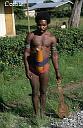
As they met people from different villages, they smiled huge smiles and made the longest two handed handshakes I've ever experienced. (Everyone who passed me greeted me in this way also.) The Golkan rally itself seemed to be only an excuse to bring the people from many villages together. The Golkan people spoke and sang from the platform, the Golkan shills - a sea of yellow - in front of the platform sang, danced, and applauded as appropriate, but the villagers sat in circles, village by village, from one end of the huge field to the other, talking amongst themselves and occasionally visiting folks from the other circles. Some traded or sold things they had brought, either grown or purchased at market at Wamena, But I didn't see any paying attention to what was going on on the platform.
I think many people only speak Dani, the tribal language, so do not understand Indonesian anyway. The younger ones who probably do have the language seemed to treat the thing more like a football match - go yellow! - than an opportunity to hear from and question politicians. Ishak, one guide, told us he was not yellow, but red, PDI, the people's democratic party, but was unable to tell me anything about the difference between red and yellow other than the red one being the sign of the buffalo (a three fingered hand sign showing index and pinkie fingers and thumb). The Jakarta Post quoted one person as saying that he joined Golkan because they gave him a t-shirt; if the others gave him a t-shirt he'd join them too.
At any rate, because of the rally we were treated to the wonderful presence of perhaps a hundred villages, a couple or more thousand people gathered in one remote place and a most beautiful river valley surrounded by verdant mountains, all at once. It couldn't have been finer. Friendlier people I've never seen. I think we made no problems.
May 16
I was to take a day hike with Ishak up in the mountains to a hanging bridge and a different village. Ishak, however, needed to get something from Wamena so went back to Wamena Thursday night and said he'd be back by 7 am Friday. He wasn't, however, so our porter let me up the trail. We first passed a village on the bank of the Baliem River. The people grow sweet potatoes and other vegetables and raise pigs and chickens. The gardens march up the steep hillsides almost to the ridges, each patch surrounded by low stone walls against the pigs. (Much of this hike was spent going up and down stiles over the stone walls.) The vegetables are planted on raised mounds, much like our raised bed at home, but the Irian Jaya gardens have raised the beds to about waist height. Harvesting is much easier than at home. The pigs seemed to roam wild, but I was told that each pig knows it's owner and will come when called.
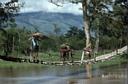
Our hike was to cross a hanging bridge over the Baliem River, but after an especially difficult creek crossing because of the slippery mud climb hanging on to tenuous roots up the steep far side, we came to a landslide bit and we were unable to continue that path. We went back about one kilometer (more difficult to slide down the steep mud than go up it!) and took an uphill fork in the path. I mean seriously uphill. The porter, of course, is accustomed to such terrain, but I'm not in good condition so I paused frequently for breath, too frequently for the porter's pace. He soon let me pass, then almost pushed me - literally, hands on my bottom - to the top of the ridge. By this time it was about 11 am and getting very warm. We had only the downhill bit left to the hanging bridge, but the path went again straight up the other side. The porter, visualizing I'm sure pushing me over yet another ridge, suggested that perhaps it was too hot to continue since we'd had to take the detour and we were much later in the day than expected. Eventually I agreed, and we began to retrace our steps. Not surprisingly, my pace going down the steep ridge was not to the porter's liking either; I kept searching for handholds because of the extremely steep and slippery angle. Here it was not mud but dust and loose rocks, only an occasional tuft of grass with roots enough for a foothold. Soon my guide ripped off a long branch, stripped it, and gave it to me for a walking stick. But with the path no wider than one foot directly in front of the other, and the steep bank on both sides, I had a hard time finding purchase for the stick, too. The porter, whose name I unfortunately never learned - we didn't share enough language to even get that far and pantomime didn't seem to do it - was smiling and patient, probably because we'd cut the outing short. We finally reached the fork in the road and headed back toward the village we'd passed earlier. The porter suggested a Mandi [in the] Sungai - a bath in the river - and I readily agreed. We scrambled down another steep mud bank to the boulder-y shore just after a patch of rapids smoothed out. The porter hit the water one side of a pile of boulders and I the other, and I had the best Mandi I'd had in a good while, with the rushing water seemingly taking a way a lot of sweat and grime. Unfortunately we had a number of kilometers to go before we returned to Kurima, and I was ready for another one, but all in all it was a dandy hike. I did not feel bad that I'd missed crossing the hanging bridge, which would have made nice photos but would have frightened me, and gone to yet another village, because we'd seen all these villages the day before dressed in their traditional best.
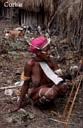
Back in Kurima Ishak had returned. He'd been out on the path in the morning trying to catch up with us, but apparently took a slightly different route, then met someone who said the porter and I had finally headed back to Kurima. I hit the outhouse, and when I opened the door back into the yard, two women were engaged in fisticuffs. Ishak later explained that one was his wife an one was his girlfriend, who had come along for the trek. (Also his girlfriend's sister and wife's sister, I think, which helps explain all the people who came with us.) Ishak had asked his wife if it was all right if he had a girlfriend, and he said she said yes, so long as she wasn't married. Now, apparently, the wife had changed her mind. There as quite a to do in the yard for a while, then Ishak said he needed to go back to Wamena and he and his wife would talk to the chief (I didn't inquire about this but would have been interested to know whether this would be a counseling service, pronouncement of law, or what) then everything would be all right and we could continue our trek. We all piled into a bemo back to Wamena, Ishak's arm tightly around his wife's shoulders in the front seat, the rest of us and our stuff in the middle and back, including a girlfriend in the back. In Wamena Bob and I were deposited back at Syahrial Losman, where we told Ishak we thought this was time he should spend with his wife and we would call a halt to the trek. He resisted, but finally relented and we agreed on a cash refund so long as we came to his house in the morning to see his family. He rebooked our tickets back to Jayapena for 11 am, and we agreed to visit him at 8 am. When we arrived Saturday morning, we saw that Ishak lived in typical Daui style. The residence compound had a fenced garden of sweet potatoes, etc, out front, fenced in this case by tightly fitted bamboo. Inside were a rectangular grass and thatch building for cooking - with the girlfriend scrubbing pots on the ground outside. A round thatched hut for sleeping; a small w.c. apparently without maudi, and another rectangular building in which the babies were sleeping. Ishak's wife was just dressing the waking babes, twin boys, which were brought outside for photos. His mother and father were busying the kitchen and garden, and his older son was toddling about after the chickens. If the father was administer, he was one of the shyest I've ever seen. All seemed peaceful on the surface, but I wondered if the girlfriend was destined for years of scullery.
Ebanus, the guide we'd originally asked for, joined Ishak in accompanying us to the airport, and even gave us gifts, the better to secure a recommendation I think. In the days since, it has been Ebanus I've recommended.
On to the next journal
Back to journal index page
Back to map page
Back to alan's home page