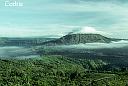
Batur Volcano
May 7 - 15
Woops. After sending that last batch, I realized I lost track of the page numbers. I'll try a different system next time. [No problems on this end -alan]
From Lovina, Wednesday, we took a shuttle bus along narrow curlicue roads up into the mountains to Pendokan, a small town clinging to the giant rim of a volcanic crater. The edge of the crater is no wider than a narrow two lane road; the town's buildings hang on to the steep slopes on either side of the road. The huge crater is a few miles across, a remnant of some ancient eruption that prompted the growth of a new peak, Ganung Batur, in the center of the old crater. The new peak hasn't grown anywhere close to the circumference of the old crater. The rest of the crater floor is covered by Lake Batur, the lava flow of the most recent eruption of Gangun Batur, in 1927, and half dozen or so villages and a small town, Kedisan, where we spent Wednesday night. We had intended to stay in a village noted for it's hot springs, but when we arrived we were told the hot springs were only for the local people, so we headed back to Kedisan, just below Pendokan on the crater floor. The scenery in the crater was lovely, with Ganung Batur towering over all and the barest beginnings of a new forest a few inches tall on the lava. At one time a couple more towns, Kintimani and Batur, were built on the ancient floor, but the towns were destroyed in the 1921 eruption of Ganung Batur. After that eruption the towns were rebuilt in the same place but were evacuated in the 1927 eruption. This time Kintimani and Batur were rebuilt on the crater rim not far from Pendokan, and their foothold appears even more precarious than Pendokan's, making me wonder if the people are taking as big a chance on the steep slope as they would be back on the crater floor.
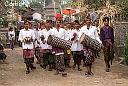
For me, however, despite the amazing setting, the highlight of our time in Kedisan was the Bali Hindu temple ceremony I witnessed but unfortunately did not understand. Our lodgings for the night, the Segasa Losman, were in 'downtown' Kedisan, about 2 km from the ancient Bali Hindu temple out of town just beyond the reach of the most recent lava field. Men dressed in carefully pressed white shirts, colorful sarongs and brightly colored and precisely folded headcloth joined women in lace blouses of pink, orange, or yellow, elegantly woven sarongs and silk sashes in the motorcade to the temple. Open trucks, bemos stuffed and motorcycles overloaded carried the throng. I was the only walker, and it was a bit slow going because of the short steps my sarong forced me to take. It was a delightful walk, though, and really fun to see all the well-dressed people pass, the women carrying huge offerings of stacked fruit, cakes, and even occasional roast ducks or chickens on their laps during transit. As I approached the temple, I first came to stalls of vendors of foods and dry goods hastily [text obscured] in both sides of the road. I had for some time been hearing a cantor's voice of a loudspeaker system, and the tones were now extremely loud. People had set up little picnic sites with the fields on both sides of the temple and were eating food from the vendors or barbecuing their own. There seemed to be nothing formal necessary, so I stepped through the gate. A few steps inside a woman asked me if I was going to go into the temple (I thought I already was). I said yes, and she said I should buy a sash; I volunteered to rent it instead, for 50% the purchase price, and she tied it around my waist. I then guessed that the temple entrance was the stairs at my left, so went in and asked, in pantomime, if it was all right to take pictures, which it was. Tables were heavily laden with the huge offerings, and people were just milling about, smoking (men) and snacking, in gender groups.
Then the cantor began a new tune, and men put out their smokes and women put the offerings on their heads, and a procession began into the upper level by the steps on the left and out again down the steps on the right, ahead of be. I couldn't see inside the upper level but finally realized that level alone might be the temple itself and these surrounding areas may just be grounds. I was not comfortable going up there since I didn't know the procedure and had no offering. Perhaps inside the offerings were blessed or something, but they weren't left up there; the women carried them on their heads back down to where I was and placed them back on the huge tables. After everyone currently present had marched into the upper level and back out, the men went back up and sat down, ritually covering the ground of the upper level. But the cantor's tune did not change, and no one person stood to be a primary speaker, so I was again without understanding. Some people picked up their offerings, boarded some conveyance, and headed back into town. Others took their offerings to their picnic sites and conversed with family and friends. I finally decided to go back to the losman and was surprised to see as many people headed toward the temple as were headed away, both with offerings in hand. When I returned, Bob asked what was done with the offerings. For all I knew, the people may have eaten them. I definitely must read up on Bali Hinduism to see what this day may have been all about.
Thursday morning we had a dandy breakfast of mixed fruit juice, banana pancakes, and requested plain tea, ie, no sugar. (Can't believe I encouraged Bob to get used to having tea without sugar because I thought that was how it would be served in SE Asia! You really have to be clear that you want plain tea if you do.) The banana pancakes are very much like Swedish pancakes, thin and crisp on the edges, deliciously fried in butter, with bananas rolled in the center. The Indonesian custom seems to be to rent the room for a price including breakfast, and the yummy banana pancakes have frequently been the breakfast main course. Other times we get apples, two buttered bread slices with tomatoes, cheese, and/or eggs between them, the bread toasted and the contents cooked by being squeezed between the halves of a metal iron held over the fire. Swell. And of course the curries, rice and noodle dishes we have the other meals are virtually all heavenly. We thought we'd lose weight! Hah!
Thursday we took a bus down (meaning both south and lower elevation) to Ubud, the artistic colony of Bali. Although the place really is a giant shopping center, full of tenacious vendors, it has some pleasantries. On the side streets, 'inside', away from the main drags, people are smiling and friendly without trying to push some ware on you. Also, there is so much tourist presence in the town, performance of traditional music and dance are available inexpensively every night. I was absolutely thrilled to see the Kecak Dance, performed by a chorus of Balinese men, and about half a dozen solo dancers. The solo dancers performed the Indonesian legend of Raman and Sita accompanied not by instruments but by the chorus. The performance was at 7:30, well after dark, at an outdoor theatre lighted by a hundred candles on a thrust 'stage' the same floor level as the three-sided ring of chairs and floor mats for spectators. I of course took the floor mat as Bob sat behind me. Soon the large chorus in black and white checkered sarongs, sat cross legged in a circle as large as the 'stage', the outer ring of singers a few inches in front of my knees. Then the singing and movements began, very much like the version done by the Seattle Men's Chorus a few weeks before we left home. I had been looking forward to experiencing the original, which was even more powerful than I had imagined. The singer sitting closest to me must have been about 70 (he's on the postcard I bought of the group) and was as energetic as the much younger men that made up the bulk of the chorus. I found myself moving to the beat of the music and swaying in the directions the chorus was swaying, but stopped short of most hand movements and did not hop up to wiggle my fingers at the dancers who were villains. I needed to scoot back on the mat to give the singers room for their routine. It was just wonderful! I have a postcard for Jamie, at church, who participated in the Men's Chorus performance of Kecak. Jamie, you'll see what you guys really should have warn. The black and white checked fabric of the Kecak Sarongs is significant in Bali culture. Many shrines and god spirit statues are wrapped in such cloth on special occasions or in times of special need. The black symbolizes the evil spirits, the white the good spirits, and the grey squares created by the interwoven black and white threads symbolize people who are not expected to be totally good but a mixture of good and bad. Although it's wearying to see the 'black is bad' myth perpetuated, I like the notion about people.
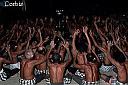
Excerpt:
Due to scheming in the palace, Rama, his wife the beautiful Sita and his brother Laksaman are exiled to the forest, where Sita is abducted by the ogre king. Rama begins his search for Sita and is joined by the monkey god Hanuman and the monkey king Sugriwa. Eventually a full-scale assault is launched on the evil king and Sita is rescued.
The Ramayana
The Ramayana, the story of Prince Rama, is thought to have been written after the Mahabharata. Long before Prince Rama was born the gods had determined that his life would be that of a hero - but like all heroic lives it would be full of grave tests. Rama is an incarnation of the god Vishnu, and it will be his destiny to kill the ogre king Rawana (also known as Dasamuka and Dasakhantha).
We stayed two nights in Ubud and took it at face value. Although it does had a small monkey reserve (at which we were almost the only people who took seriously the 'please don't feed the monkeys lest they become spoiled' signs), the town really is a tourist center, so we bought stuff and shipped a large box home. According to Lonely Planet, if we negotiate appropriate prices, this is a good place to buy art, woodcarving, etc. We also bought some things at Lovina, so if the boxes beat us home (doubtful), don't open them 'til we return.
I had hoped to be able to arrange our flight to Irian Jaya in Ubud, but was unable to, so we took a bus to the airport near Kuta Beach on Saturday afternoon. The Garuda office at the airport claimed they couldn't help me either, since it was after 4 o'clock, but even if they could they were going to use up our entire five-stop passes on only two destinations. This of course could blow the budget sky high, but to calm me down and ease my jagged nerves, we took an expensive bungalow 'inside' at Kuta and looked forward to the swimming pool the next day. Logic tossed to the wind! In our beautiful room (with hot water shower!) and balcony overlooking the lush garden surrounding the pool, Bob and I studied L.P. for alternate plans if indeed we did not get five stops in Indonesia. Of course, nothing sounded as good as the Irian Jayan mountain valleys where various peoples have continued to live according to ancient traditions until sometime in the 1930s or so, when they were 'discovered' by the Dutch colonialists. Even so, the only access to date is by air, mostly by small missionary planes and the ancient traditions remain strong. Using the 'when in Rome' theory, before going to bed, I leaned over the balcony rail to the window box overflowing with leaves, blossoms and vines, bent a branch in the shape of the offerings ubiquitous in Bali, and placed some dropped blossoms inside. The next morning I strode off toward the Garuda office in Kuta, avoiding the hawkers' eyes and turning my back on the most persistent (I don't like acting like that toward people!), until I finally moved up to the Garuda desk. The man who waited on me pointed out that the restrictions changed as of April first, so our five-stop passes were technically not as valuable as had been explained to me when I ordered them at about April first. After a difficult conversation, in which it was determined that he was just an employee, no managers worked on Sundays, all he could do was go by the printed rules. I had saved for many years for this once-in-a-lifetime trip, and I was embarrassingly (to him) upset and on the brink of tears, we found a face-saving way out of the impasse. We agreed it was entirely possible that the information on the regulation changes may have been in transit from Garuda headquarters to the offices around the world at the time I made the arrangements in Seattle, so the Seattle agent may have understandably explained the old rules to me at the time of purchase. I left the office with a new friend to remember and tickets in hand to Irian Jaya, then Ujung Padang and Manado on Sulawesi, and Balikpapan in Kalimantan on Borneo. As I entered our expensive room, I picked a fallen blossom from the path and placed it on my Bali offering circle.

Sunday afternoon we swam more than an hour in the beautiful pool in the garden, then boarded the 7 pm plane back to Jakarta, where we changed to the 9 o'clock flight through Ujung Padang and Buru to Jayapura. We arrived at Jayapura airport, which is really in a town named Sentani 37 kilometers from Jayapura, at 7 am Monday and were able, even at that hour, to book a room for Monday night, where Bob promptly fell asleep. I had slept fine on the night flight, so set out to make arrangements to go to the interior. Our losmen is a less-than-five-minute walk from the airport, and the police station is inbetween. According to LP, the police at Sentani can arrange the suratjalan travel permit(?) for us to go to Wamena in the Baliem valley. I asked the officers, who talked among themselves, made a phone call, and invited me to sit down. Soon a man whose mouth was red from betelnut came onto the porch where we were sitting and explained that he had been called to tell me about he suratjalan. It seemed the officer who could make out the permits was serving as a security officer during the election campaign, so was not present in Sentani. I should instead take a bemo to Abe, change to a bemo to Entrop, then change to a bemo to Jayapura, where I could easily walk to the police station and get the suratjalan. I did so, and a couple of hours later I had jumped through all the hoops, made appropriate photocopies, and had appropriate documentation in hand. I celebrated with a walk along Jayapura's waterfront, photos of kids 'surfing' with small hunks of plywood at the mouth of a river and photos of the ships in port, ranging from rusty wrecks now used as squatters residences to shiny new tankers, and a dandy lunch at a Jayapura warung.
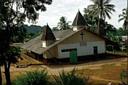
The missionary presence in Irian Jaya is clear; four christian churches were within three blocks in Jayapura, including a Pentecostal Filadeifia, and some people had crosses on chains around their necks. I saw many more churches on the three-bemo rides between Sentani and Jayapura. In the second half of the way back, I sat next to an emaciated older man with a walking stick, who chewed betel nuts, tossing the shells out the open window, and ate from a long green bean he dipped into a white powder folder into a paper the entire ride. I wondered if the white powder was another drug of some sort to enhance the high of the betel, but LP is silent on the subject. At the rate he was going, he would be out of betel nuts and white powder and beans before he returned home from the market. At least he was getting some vegetable.
In the bemos I was tickled to note that a number of people in this state (province?) are as wide as I am. Very generally speaking, the people who appear to have a stronger Papuan heritage are thicker than those with the Malay heritage more typical of the other states we've visited. They're not as tall as I am, certainly, but it is nice to not necessarily have the widest behind in the bemo and thus be the brunt of glares about how much of someone else's space I'm taking. The other wonderful thing I noted on my junket to Jayapura and back is that once again, as in West Sumatra, the people are merely people, smiling, friendly, eager to be helpful, and not merchants. Folks would converse with me at virtually every stop, but only to say hello, ask where I was from, or offer to give directions or walk with me so I wouldn't lose my way. Once again warm eyes and big smiles surrounded me with no ulterior motive. Lovely.
A huge lake, Danau Sentani, rungs along the 37 kilometers between Sentani and Jayapura, and continues more than a hundred more kilometers west of Sentani. On Tuesday, today, Bob and I were set to picnic and swim on the shore of the lake, but there is no park on the shore. Shore land is valuable for stilt houses with fish ponds underneath and for banana, coconut, papaya and jackfruit trees. We were directed to a restaurant on the edge of the lake where we were told we could rent a boat, motor out a way and swim from the boat. Nope. The large wooden cruiser came with driver, deckhand, and route to travel including island village stops, no pausing to dive off the bow. The island village was great fun, though. Bob spent a lot of time laughing and shaking hands with nude toddlers. I walked along the shore, between the trees and hills on the island side and the stilt houses over the edge of the water, and watched women washing clothes and children, teens folding nets into dugout canoes and men setting out to fish in the dugouts. Each house had one or two fish ponds underneath and large decks on which cooking and washing were apparently done. At the top of the hill in the middle of the island was a large church and I passed two cemeteries prominently marked with several crosses. On our way back to Sentani by bemo, as we passed many more churches, Bob and I wondered how comfortable we were with such a large presence of our obviously foreign culture. As Bob said, 'They probably had a perfectly good religion before.' We seemed to agree we weren't very comfortable with the thought that people may have been wrenched from something dear in the name of God. I wish I knew if the missionaries had tiptoed and taken off their shoes in the presence of God who was there long before they arrived.
Wednesday morning, tomorrow at 6 am, we must be at the airport to fly to Wamena in the Baliem Valley, where we hope to spend a number of days and visit people seldom visited. I pray we do no harm.
On to the next journal
Back to journal index page
Back to map page
Back to alan's home page