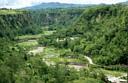
Sianok Canyon, Bukittinggi
April 27
Although Lonely Planet describes the Minangkabau as matriarchal people, I was not able to understand enough of what was going on in Sungai Pimbang to recognize people's social or family positions. Yandra's sister showed me a chapter in the Koran on women that cautioned men to take no more than a few wives, described inheritance to females as half that to males, and detailed precisely how distant a relative a woman must be for a man to marry her (not very). As I recall it gave only unfaithfulness as grounds for a man to divorce a woman, but no grounds for a woman to divorce a man. Yandra's sister is content having her husband provide for her. She said in West Sumatra a man could take no more than four wives.
In Payakumbuh we also walked around the neighborhood, called a village by a young man who walked with us. In the midst of the medium sized town, the 'village' had lightweight wood and fiber houses with outhouses on stilts above the many large approximately rectangular fish ponds separated by narrow sod paths. A few small fruit orchards, rice fields and chili fields dot the area. Other than for catching human waste, I am uncertain of the purpose for the fish ponds, but they have been virtually everywhere we've been in West Sumatra, even places with indoor w.c.'s. In Sungai Pimbang we were told to throw our banana peels in the pond, and the fish would eat them, so they may be for garbage disposal.
Bukittinggi is a small town in the mountains with both steep and gradually sloping winding streets, several of which turn into staircases as you walk along. Monday morning we walked to Panorama Park, which overlooks Sianok canyon. The view is indeed lovely, with rice and corn fields in the valley below and a river winding between two villages. The real drawing card, however, was some caves used by the Japanese in W.W.II to store Indonesian prisoners. Bob decided not to go in the caves after all, but was pleased to see the place.
April 29
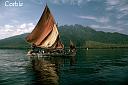
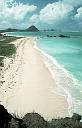
From Bukittinggi we took a bus down to Padang, where the full impact of the coastal heat hit once again. We immediately hired a cab to take us to Pasir Putih, when our old book identified nice accommodation on the beach, but no Losman (place to stay) was there. Luckily, a young man in Bukittinggi had told us about a nice Losman at another beach nearby, Uncle Jack's Homestay, which Bob pronounced 'perfect' the moment we arrived. This morning I sit under a thatched umbrella on a palm stump writing on a rough table attached to the umbrella trunk. Children from the village are playing in the sand and surf 15 and 25 feet away, and small fishing boats are making their way to sea. Bob has been in conversation since breakfast with a man from New Brunswick. He and his wife were going to get new jobs and move to Vancouver, so before they did they decided to take some time off. They've been traveling for 21 months and have been almost around the world. Another couple is from Holland; he gave me some hints on Bali so we can find a comfortable beach without having to go to Kuta, ugly tourist capital of the world, according to what we read. We three couples are the only ones here at Uncle Jack's. The beach is many miles long and I see no one along the sand as we look north and south. Jack's wife fixes dandy Padang meals. A cooling breeze blows off the water. I agree with Bob; it's perfect.
First swim of our trip Tuesday, then again Wednesday. Wed morning I walked down to the fishing village, Tabing, to watch the fishermen. I was too late to see the boats set out to take the purse end of the net far from shore, but watched the men ashore who held the line on each side of the purse, then began pulling it in, about a two hour process. About six men and boys work on each end of the net, five pulling and the sixth coiling the line as the last man dropped it, before he walked forward and replaced the first.
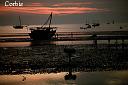
Periodically coilers would trade with pullers, and as the net came closer to shore, the line became closer together, so people would trade jobs from one line to the other. The procedure was not hand over hand pulling. Each man had a cloth tied around his waist. When it was his turn to go to the head of the line, he would wrap the tails of his cloth twice around the line of the net, face the sea, hold the tails of his cloth tightly, and walk backward, digging his heels firmly in the sand. To dry the rope after pulling about 50 metres, he simply unwound one of the tails of his waistcloth. When the purse of the net finally reached shore and all the men were together in a small circle, I could see hundreds of three, four, or five inch fish flopping angrily in the net. Once man brought three baskets, I would say about a bushel in content but taller and narrower than my image of a bushel, and the morning's catch was poured out. Although only two baskets were filled, I sensed no disappointment. One large - 15", say - fish was tossed aside, then two handfuls of the small fish were tossed next to it. The man I thought has been working most energetically gathered these fish in a cloth and took them with him. Perhaps it was his net, and this was his extra measure. It may be that the old techniques differed slightly from the new but I felt as if I could have been on the shores of Galilee two thousand years ago.
May 1
By now I've forsaken all notions of western propriety and wear only two items, a shirt and long o short trousers, plus sandals occasionally. Should have come to this stage a week and a half ago. We've enjoyed our conversations here with various couples from Holland, who have come and gone since we arrived, but have spent most of our time with Natalie and Lowdin, who will be moving to Kansas (?). That Natalie is a crib whiz. Although I've skunked her twice, she's beaten both Bob and me twice. But I'm ahead of Bob in the dominoes tournament. I had a gangbuster hand this afternoon, six of the seven fours, including doublet. There was no catching me. Plenty of time here at Jambak beach. (Posur Jambak) to pursue such entertainments during the daily afternoon deluge, which can go on for several hours. And plenty of cracks in the corrugated tin porch roof, as you can see from the signs of water on this paper. It's fun to watch the children dance under downspouts and pull boats made of cut waterbottles through the huge puddles. At the same time the cows cower under the eaves of the w.c. building toward the public beach next door. This village seems to have livestock aplenty; chickens and chicks everywhere you look, a number of goats wandering about or napping on palm stumps, and Bob counted 22 in the herd of cows that usually similarly wander almost anywhere until someone throws something at them to get them away from a certain place. Plus of course the village has fish and coconuts, but I've seen no rice fields. Several of the children trot off in school uniforms every morning so there must be enough money for school fees.
This morning I walked in the opposite direction of the fishers I watched yesterday, but of course found more fishers. The first man I came to told me he was fishing for recreation, not money. He had a nylon line with three hooks hung under a weight, which he swung round and round like an old slingshot then released into the sea with a giant leap. He then settled under a coconut palm for about one cigarette's worth of time before he pulled it in. This was not a good morning for fish, he said. He had one four incher when I told him I would walk on, and only one more when I returned more than an hour later. I had the impression he may have been waiting for my return, because he packed up and went home as soon as I got back. He was not disappointed at only the two small fish; it was only for recreation.

My walk took me to a place where the ocean either met a river or had a narrow inlet into the land. I think it was a river. Numerous small fishing boats tried the water just outside the bar, and other boats were anchored on the river around a bend from the ocean. People there were dipping baskets in the water, I suppose, to catch fish. One person was digging in the mud bank. Numerous little crabs skutter across the edge of the surf all day, and tiny clamshells are all around, so perhaps that person was looking for shellfish. On the oceanside I sat on a coconut at the surf for twenty minutes trying to get a picture of a 4" crab scooting by, but the thing was too fast for me to focus. At about 10 o'clock, one fishing boat in the ocean headed into the river. Although the sea was extremely calm, the two fishers in the small catamaran had to paddle with vigor to get across the bar.
The point of land where the ocean met the river had sparse vegetation. Closer to Uncle Jack's the shore was lined with dense coconut palms, then closer to the point vegetation thins to small, shrubby broad leafed trees. But near the point I saw several seedpods for the broadleafs, a few of which had sprouted in the salt-drenched soil. Even a coconut palm or two were trying to get a foothold. But judging from the surrounding lack of trees, I suspect their efforts will be short lived. on the way back I saw a few trees that looked like evergreens scattered among the broadleaves. As I came closer they looked like fir trees, fir bark and long needles, they looked much like the sea grass kind of stuff that grows near beaches at home, with little sections that snap off, and they taste like it too. but they have little 1/2" cones. A fascinating tree.
Tomorrow morning at 7:30 we take an opelet to the airport to fly to Bali. Since we won't arrive until almost four o'clock we'll need to stay somewhere near the airport for the night before taking a bus up to Lovina beach on the north the next day.
May 4
Uncle Jack drove us to the airport Friday morning. On the plane to Jakarta we conversed for a long time with a man who teaches economics at the university in Padang. His name is Syafruddin Karimi (don't pronounce the 'a' in his first name, so it's sy-fru-deen). He studied economics in Florida from 1989 to 1995, and during that time took a two-month course in the UK. He talked about the election campaign currently ongoing in Indonesia, and about how different the political system is here compared to the US or UK. In Indonesia, the people look to the government as a parent caring for all the people of the country as it's children. If the government makes a mistake, the people do not criticize, but try to understand what the government has in mind, the way a child does not criticize when the parent makes a mistake, but tries to understand. (Can't say that was my approach as a child, certainly not as a teen!!) Syafuddin said the government had learned and grown in wisdom a great deal between 1989 and his return in 1995. Now the government pays more attention to the people's needs and desires. He mentioned Myanman (Burma) which, apparently, was sanctioned again by the US just last week. He said the southeast Asian countries treat Myanman like a naughty child. They try to teach it better ways, so the people won't suffer, but do not cut off trade. The trade provides food for the government and people to eat. Syafuddin says you cannot teach a child that is too hungry, so cutting off trade is no way to get Myanman government to mend it's ways. He also talked about Indonesia's controversial transmigration program. The idea is that the island of Java is too crowded, the people don't have enough land to farm, and the cities don't have enough jobs for the untrained people. The government builds houses for a village in a location that provides enough land on some other Indonesian island, Sumatra, say, or somewhere else - gives people a certain amount of money and seeds (?) for enough rice for a year. The government provides the house, land ,and transportation and hopes the people will get a good start and have a good life in the new village.
Syafuddin said he knows of one successful new village in West Sumatra and several others elsewhere. Problems arise from both the government and the people who move. Sometimes the people accept the government's offerings, but sell the house and land then move back to the place they came from. Sometimes the government doesn't actually get the money or rice into the hands of the people, or the houses are unfinished, or the land won't grow a thing. And sometimes the people who go simply won't work so they don't have a good life in the new place either. Also, sometimes the forest is cleared to make way for the new villages, and many in this country and other countries think that is very bad. So, Syafuddin says, it's a good idea in theory but in practice has some real problems.

We arrived in Kuta Friday afternoon around 4 and took a cab to an inexpensive Losman in an area of homes and losmen. We saw no beach driving from the airport to the Losman, although we knew it was there because we could see it as the plane landed. We were in a real maze of packed houses and extremely narrow roads. High walls around everything.
After depositing stuff in our room, I walked out to the main road and was immediately accosted by throngs of vendors with watches, rings, bracelets, hats, shoes, necklaces, and shirts, etc., etc., ready to hand to me for the absolutely best price. I fled, and did not return until Bob and I went searching for the beach, which we finally found through the largest number of sales stalls and strolling vendors that could possible exist on a half mile stretch of road. Once on the sand the real world was again visible, but the atmosphere was far too sour with commercials. Our room faced a garden courtyard between two rows of rooms and it was very pleasant to sit on the porch and have a game or two in the evening. The next morning, Saturday, the bus we had arranged picked us up at the door for the drive across the island to Lovina Beach.
May 5
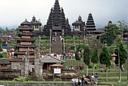
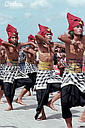
We left Kuta at 9:30 Saturday morning for a fascinating drive across mountainous Bali to Lovina Beach, on the north coast. Bali's center is mountainous, and we read that it is toward the mountains that we can find Bali's soul. In the eleventh century CE, Hinduism came to Bali via Java as a result of a marriage between a Bali king and a Java princess. However, Bali already had strong religious beliefs so the new Hinduism was laid over the existing practices, resulting in a Hinduism very different from India's. Evidence of the strength of Bali's religion is apparent everywhere. Good spirits dwell in the mountains and bad spirits haunt the woods and desolate beaches, so every day, several times a day, offerings are put on the ground, on fences, on tables to placate the bad and pay homage to the good. You have to watch where you step to avoid tromping a little bag full of flowers and spice, which is someone's offering to something. Also every home and business have several shrines to a number of Hindu god symbols. These may be made of carved cement with layers of thatched roofs or maybe bare bamboo stands, or anything inbetween, but each receives it's flowers, tea, spices, and incense sticks many times a day. Traditional houses are surrounded by high walls to prevent evil sprits from entering. The ornate gate in the walls have little walls just inside them, which allow people to enter but make it difficult for bad spirits, which have a hard time turning corners. Peeking over the walls are the roofs of the many shrines. The drive across the mountains was absolutely beautiful. Terraced rice fields virtually everywhere. Temples and shrines abounding, even in the fields. Coming down on the north side we saw fewer spirit gates, so maybe there are fewer bad spirits here
May 6
Saturday we took a room at Parma Beach Homestay which is more a hotel than a homestay, that reminds me a great deal of the place we stayed in Guayabitos, Mexico, last year. Between the road and the beach is a beautiful garden lot which is dotted with little duplex bungalows. We have one overlooking the garden and the beach, splurging at 20,000 rp ($US10). Perfect little porch for game playing in the evening. Sunday morning we did absolutely the most fun thing we've done so far: took a three hour cooking course from check Djani, who has a little restaurant across the road. Djani had recipes typed and ready for us; the ones we had chosen the night before were stapled together in a little packet with a bandaid sensibly attached (which of course I needed). We started by making a soup of jackfruit. I thought it would be sweet, but it wasn't, and it was absolutely delicious. If I can find the jackfruit, I'll make it at home. We have all the necessary seasoning except maybe saffron root. We also made curry tofu and curry rice, the recipe for which Djani had revised Bob's desire for fewer chilis, which was also delicious. In addition there were corn fritters, black rice pudding, and tempe, a kind of bean curd dish we had almost every day when we were in West Sumatra. The food was absolutely phenomenal. I had thought maybe I'd lose a pound or two over here, but that's clearly not going to happen in Indonesia.

Monday we took a bus tour around the northern part of the island. Gitgit waterfall would have been a lovely sight, and the hike to it would have been a beautiful walk though the tropical forest, except that the path was lined with vendors who would not stay in their stalls and the viewing platform at the foot of the beautiful falls obstructed most photos you tried to take. The Hindu mother temple for Bali was beautiful, situated on a lovely lake and surrounded by carefully manicured gardens. The Buddhist monastery was also striking. The elaborately carved courtyard is perched on the side of a hill with steep steps going up to a bell tower, a large shrine, a residential complex and what looked like a worship center or gathering center of some sort. Words were painted on the risers of each staircase, and I wish I had learned what they said. As it happened, the driver of our tour had very little information to offer.
Tuesday is hanging around on the beach day, which means fending off vendors, but now that I've spent a few thousand rupah I'm at peace. Probably push off tomorrow for a night at Penelokau, near Lake Batur up in the mountains then spend a night in Ubud before flying to Irian Jaya.
On to the next journal
Back to journal index page
Back to map page
Back to alan's home page