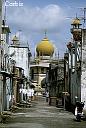
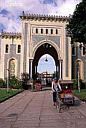
Sultan Mosque at the end of Arab Street, Singapore
April 22
I've repeatedly told people that the reason for spending this sabbatical time in the south east Asian countries is to learn from the cultures that are dramatically different from ours. Singapore is so westernized I have not been aware of a dramatic difference. Chicago Bulls jerseys are more common that sarongs, and Huckleberry Hound and Chicago Hope were on the tv at the shopping center with the shoe store yesterday. But I am aware of an understanding that is being reinforced in this city of many cultures and visitors from all over the world. Intellectually I have known that a person's appearance says nothing about where that person lives. At most, it hints at one's ethnic heritage. But when I guessed that a person was from the U.S. based on the sound of his brief greeting and was dead wrong - he didn't speak English, I realised that I still have a way to go before I have truly accepted all people as actual brothers and sisters. I'm still categorizing them by various clues and deviding some are only distant cousins. Perhaps this truly will be a great learning experience. Tossed together in this beautiful city, we all do seem much more like one family of God.
This morning is the time to make final arrangements to travel to Sumatra. I ever so wisely got on the correct bus to the Arab Street neighborhood, the place where I was to find Airpower Travel at 29 Sultan's Gate. I got off the bus at the right place but couldn't for the life of me find Sultan's Gate. Most of the people I asked were not aware of the street, those that were directed me to (I thought) an unmarked street that did not have any businesses on the appropriate block. Foolishly, I had not brought the phone number with me and could not find it in the yellow pages available at the Garden Landmark shopping center. Frustrated at the waste of time, I rode back to Bencoolen street and telephoned from the guest house. The agent gave me a landmark, Plaza Hotel, and I set off again. This time, when I got off the bus, I landed in the midst of a crowd looking at something in the street. I joined the gawkers, of course, and was surprised to see a huge clearing patrolled by police officers seemingly guarding a body covered by white plastic held down with stones. Traffic was directed around the clearing, and there was no attempt made at all to conceal the shock of the body. I realised that at home if there is a fatality in a traffic accident, even those who are first to pass by do not really see the body. After I watched for about 10 minutes, expecting to see some kind of pick up vehicle every second, a man with a camera ran through the intersection, holding his hand up against the traffic. He rushed to an officer, many gestures were made, then the two officers pulled the white plastic shroud off the body. The photographer took many shots of the body and onlookers, and of children peeking through the hedge of the primary school playground adjacent to the accident site. I waited about 35-40 minutes, and still the poor dead man lay there, re-covered, with no one to pick him up. I wondered if it had been a jaywalking accident and his presence on the street was meant to be a lesson; jaywalking is ubiquitous but could be highly fined. I finally went on to the travel agent, where arrangements for the flight to Padang took almost an hour, and by the time I returned to the intersection, everyone was gone.
April 22 - 24
Tuesday, after securing the plane tickets to Padang, was all travel: Bus to the Singapore World Trade Center, then boat to palace Batain (Batain Island) south of Sentosa and the other Singaporean islands, in Indonesia in the Riau archipelago. From the water, Batain appeared almost stripped bare of vegetation by what looked like gravel pits, and it gave the same appearance as we traveled across the island by taxi to the airport. Batain is supposedly being developed into a resort area especially for wealthy Singaporeans, but nothing in any way appealing caught our eye during the hour's drive. On the flight to Padang we met a nice young man nicknamed Lubuk who spent some time conversing with us. When we arrived in Padang, Lubuk invited us to his sister's wedding, Friday, in a village outside Payakumbah, which is east of Bukittinggi. We excitedly accepted and assured Lubuk we would be there.
We took a room for our first night in Padang and promptly put in. It was 7 o'clock, pitch dark, and hotter 'n hades, much more so than Singapore. Wednesday I wasn't feeling up to snuff so it was my turn to spend hours lying in the room while Bob did some exploring. When he came back a few hours later, it was to get something to write our address on for a fellow he'd fallen into conversation with. I went out to meet him, and soon we'd spent the afternoon on the beach with him. He, Mr Riski, was curious about U.S. government, how people lived, available education & jobs, etc. We had the same questions for him, but our understanding was as limited as his English. Thursday morning Bob and I went to Padang Market mainly so I could find something appropriate to wear to the wedding, and Wednesday's Mr Riski found us there. Before we parted, we promised to go to his hometown Saturday. Then we hpped on a bus to Bukittinggi. It was an entertaining three-hour ride, hairraising ziggin and zagging with oncoming vehicles on the two lane road, sharing the bus with baskets of vegetables and potted plants, but all the while watching lush mountain greenery, rice paddies, and small villages whiz by.
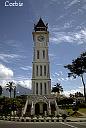
From the Bukittinggi main bus terminal a minibus took us to the street on which the budget traveler rooms were per Lonely Planet. The minibus had a driver's seat that held three small people; the passenger seats were perpendicular to the driver's seat and about 5 feet long. Bob and I pushed forward with our large packs off our backs, each ending up taking the space of two people on the benches with our packs finally settled beside us. It was about 4:30 pm, time to pick many people from work, so one after another crowded onto the benches beside each of us. Bob put his pack on his lap and they crammed in two more people, then it was time for us to get off. Good grief! The others thankfully passed our packs out the back door of the minibus, but no one stepped temporarily off, and I crunched over and collowed a stooped Bob as he squeezed between knees, then bent and popped out the back door. The people were very kind, though, as I said thank you repeatedly on our way through, and muffled their laughter at our huge sizes until they were halfway down the block.
We put in at Murmi's room with two singles for 8,000 rupich (US$4), window with closing shutters and bath just around the corner. Murmi's is the first class place to stay listed in Lonely Planet and is full of "Europeans", including us. We're really getting into the swing of the Indonesian (and part Asian) style bathrooms, toilets in once place, bathing area in another. At the toilet you squat on a raised platform with a ceramic hole in it, then use your left hand to splash clean water on yourself from the built in cement basin or plastic bucket on the floor to your left. Shake, redress, then use the large dipper in the basin or bucket to flush the hole. A drip dry system you needn't apologize for. In previous places we've encountered our typical 'high' western toilets combined with the bucket and dipper system, but the splashing clean then involves splashing trousers, which is not so good. Best to go whole hog. I'm almost sold on the system.
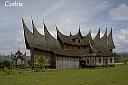
Bukittinggi tonight sounds like a typical Indonesian town, compared with the few we've seen so far. Roof line architecture is striking, planned after Bull's horns according to what we've read. Most are non-rusted tin roof but up in the mountains near Bukittinggi we've seen several thatched roofs. Transportation people swarm the streets, trying to drum up business. Buses, minibuses, opelets (smaller still) and Bemos (one more size down) are privately owned and each apparently licensed to run a particular route. Destinations are painted on the windows and sides, and driver's assistants lean out windows shouting destinations auctioneer style, "Bukittinggi-tingi-tingi-tingi'; 'Bukit-Bukit-Bukit'; 'Tingi-tingi-tingi-tingi.' I remember the same style in Mexico so many years ago, when the neighborhood Quiappo sounded to me like Babble-babble-babble.
The sounds diminish as Bob and I settle in for a good night's rest before tomorrow morning's push to Suliki for the wedding of Lubuk's sister. I decide nontheless to install my carefully purchased earplugs to muffle the contrasting sounds of the transport hawkers, the roaring-putting motorcycles and scooters, and the slowly clop-clopping mule-drawn carts (or are they horses?)
April 25 - 27
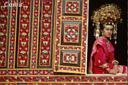
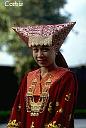
Friday morning, the 25th, we crawled into a minibus and rode up to Suliki, actually a little village called Sungai Rimbang, for the wedding. First thing we learned was that the nickname Lubuk is not used by the people in the village; the man who invited us was called Yandra (a in Indonesian is pronounced like the a's in Maag). Second thing we learned is that the wedding was for Yandra himself, not his sister as we had thought. We arrived about noon. Yandra and the other men went to pray, then Yandra and his bride dressed in amazingly elaborate red and gold costumes, seated themselves on a gold settee in a room decorated equally elaborately with red and gold wall hangings and gold parasols. They sat in the room receiving visitors for many hours while the rest of the large family and guests ate, visited and listened to traditional music by Minangkabau singers and instrumentalists. Yandra explained later that even though one or two of the instruments were traditional, the rendering we were hearing had been modernized. Except for the unusual instruments, much of it sounded to me like modern rock. Periodically during the afternoon all the men, or all the women, would go into the house to eat from a special banquet spread on the floor the length of one room. Yandra's father asked me to come in to take pictures of two of these ceremonial eatin events; at one a man was leading what Yandra's father called a special ceremony. Yandra and his bride did not take part in any of these gatherings. The one reading was the closest thing I saw to our pastor's or magistrate's role at our weddings, but the bride and groom were not even present. At sunset, about 6 no'clock, Yandra and his wife changed clothes and I was called into the sitting room to take another picture, this time with Yandra in a dark suit and his wife in a beautiful white western wedding dress. The cost of this event must have been astronomical. Costumes for the bride and goom, lovely new dresses for all the family, two tents outside against the rain (necessary), banners on the road to the village, two meals and countless snacks for the 200 or so guests plus children, and the special celebration food inside. According to Lonely Planet, the Minangkabau people typically do very well inancially. If your family is going to sponsor a wedding, you'd darn well better.
The music went into the evening until midnight. Almost no once danced, although Yandra said they would. in Minangkabau culture, or Islam religion, I'm not sure which, unmarried people may dance only with partners of the same sex. Yandra's sister encouraged us to dance - okay for a married couple, and we managed a passable swing to the music. After we started, word spread quickly and people pushed out of the house and in from the lane to watch, smiling and laughin and to heartily applaud. We had barely finished when Yandra's grandmother asked me if we would dance again. I begged off, but when she asked again an hour or so later, we complied. The only other people who danced were teenage boys and little children. By 10:30 we were exhausted and were invited to rest in the highly decorated room where Yandra and his wife sat all afternoon. I felt as if we were invading a sacred space, but Yandra's sister assured us this was the appropriate place for us to sleep. A mattress was pulled onto the floor, and we lay fairly comfortable in view of anyone in the kitchen. We felt highly honored.
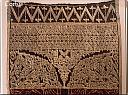
Saturday morning we ate in the kitchen (all meals spread on mats on the floor), then Yandra, his uncle, and five others from the family boarded the minibus with us to Payakumbuh. In Payakumbuh the entire wedding party setting & process was repeated! It became too late to try to go to Lintau to see the young man we met in Padang, so about 1:30 we hopped a regular bus to Bukittinggi. This time we booked at Nirvana, next door to Murmi's, which turns out to be 1,000rp less expensive ($.50). Sunday was basically a rest day, but we did take a mini tour to Pandai Sikat, a village known for weaving Songket cloth. This intricate work is done exclusively by women with much patience. For a cloth about a foot wide, progress averages two centimeters a day. Silver and gold threads are woven through silk or cotton threads to form delicate designs good on both sides of the finished product. We admired the first quality items, but frugally purchased a fourth quality (not so many gold threads woven through cotton, design good only on front) runner for the buffet. We figured we'll refinish the buffet top, lay on the Songket cloth, and cover it with glass. Should be lovely. We also watched men doing wood carving and admired the finished pieces, from small wall hangings to large ermoires (sorry, sp?), all with highly detailed carving on them.
The Minangkabau people tell a legend to descibe the origin of their name and to explain the design of their houses:
About 600 years ago one of the kings of Java, who had ambitions of taking over West Sumatra, made the mistake of sending a messenger to advise the people of his intentions and ordering them to surrender. The West Sumatrans, being neither gullible nore stupid, were not prepared to give up without a fight. So as a way of avoiding bloodshed they proposed a bullfight between a Javanese and a Sumatran bull.
When the time came the West Sumatrans dispatched a tiny calf to fight the enormous Javanese bull - a ruse which came as a surprise to both the bull and the onlookers. the calf, which appeared helpless, charged straight for the bull and began to press it's nose along the bull's belly searching for milk. Soon after the bull let out a bellow of pain and took to its heels with blood pouring from its stomach and the calf in hot pursuit. When the bull finally dropped dead, the people of West Sumatra were heard to shout, 'minangkabau, minangkabau!' which literally means, 'the buffalo wins! the buffalo wins!'
An alternate explanation for the name is that it's a combination of the words minanga, a river in the area, and Kerbau, meaning buffalo. I like the story much better. It's easy to see how legends and stories survive to be memorialized over the centuries; they're far more entertaining.
In Sungai Pimbang, Yandra's village, in a mountain valley a hair south of the equator, we walked around the area with a young man named Ade. Many houses were made of wood and strips of some type of plant, although some were stucco'd brick, but all family houses had plain tin hip roofs. the Minangkabau roofs are present on all government buildings, many businesses and even vendor carts, but perhaps they are too expensive for family homes. Ade believed his was a typical Minangkabau village and we, he said, were the first people from the U.S. to visit.
Yesterday we sent a card to Mr Riski in Linta apologizing for not visiting his village. I suspect he will be very disappointed, judging by the reception we received in Yandra's village. I hope our sending photos of Riski and us when we get the film developed will help.
West Sumatra is strongly Muslim. Everywhere you look you see mosques with their distinctive roofs, women with covered heads, the cloths called selendang in indonesian, Men with a certain hat, or the moon and star symbol. Several times a day the call to prayer is broadcast by loudspeaker across the town. We are virtually bombasted by one religion at all waking hours. In the U.S. we claim freedom of religion, but bombast everyone with Christianity. It must be very difficult for people of other religions to be comfortable in our country. No wonder different cultural groups tend to cluster together. Like the story of Adam, who may have been unhappy with the other creatures until Eve came along, when he may have said "this one's like me." I am eager for our political pendulum to swing back the other direction so there is not so much outcry to further push a certain type of religion on people. The God I know is not so narrow.
On to the next journal
Back to journal index page
Back to map page
Back to alan's home page