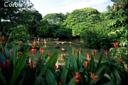
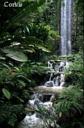
birds at Jurong bird park
We've now settled in a funky guesthouse in our own little room with a fan. We seem to have started Singapore by blowing the budget entirely. After a splendid visit with Dad and his friend Jess at the Los Angeles Airport, we joined the throngs of others who perched sardine-like for the next 18 hours to Tokyo, where there was some equipment delay, but 3 1/2 hours later we hopped on another 747. This one had room to spare, so I lifted the armrests on a center row of 5 seats and happily slept the 6 3/4 hours to Singapore. The trip had been long and wearying, but uneventful, until the pilot announced there had been a threat on the airport, albeit not our aircraft, so there would be another delay before we could disembark. When we finally did unload, we saw officers surrounding the foot of our stairs and a fire engine and other official vehicles at the ready. We understand something extra was done with the bags that had been checked, but since ours weren't, that was the end of the excitement for us. Immigration procedures at Singapore's Changi Airport are efficient and pleasant and in no time we were out front asking a cab driver to take us to a cheap hotel. After forking over S$95 (About US$65-70), before we went to sleep I checked the book for a reasonable, easy-to-get-to guest house. The hotel was at 25 Bencoolen road. According to the guidebook, the best guest house is at 27 Bencoolen Road, right next door. So here we are, splurging on our own room at S$30, with a double bed with a bottom sheet and pillowcases, an open window, and a fan. Not white glove clean, but the proprietor is friendly as can be and the young travelers are informative. Ate at food hawker stands tonight for S$3 a piece - yummy, but it was too much for me to finish.
Had an absolutely dandy afternoon at the Jurong Bird Park, which features, of all things, the world's second largest penguin exhibit. We noticed that those beautiful creatures lived in an area enclosed by glass and were thus not subjected to the equitorial heat and humidity the rest of us are experiencing. The park houses huge collections of species, both in cages and several aviaries, and puts on demonstrations of birds' hunting and fishing skills, including hawks, falcons, owls, and vultures, and demonstrations of birds who can do tricks and talk, etc. One vivid green fellow sang to us in three languages, each readily distinguishable. The programs, signs, and printed materials at the park and everywhere else we've been so far in Singapore have all been in English, but most conversations we've overheard has been in either Malay or Madarin.
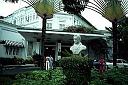
Popped into Raffles Hotel this afternoon, just to have a Singapore Sling you know, and happily relaxed in the elegance, hoping our day's grime wasn't too noticeable. I boldly asked the server to take our picture once the drinks came, then later noticed that virtually everybody in the place was doing exactly the same thing. You'd only do it once, though, the drinks were S$18 each and too sweet for my taste, but the little silver dish of cashews (whole) helped somewhat. Thought we'd pop into the market for a bottle to take back to our room, but when we were told the price was S$52 a litre for vodka we changed our minds. Found some alcoholic lemonade in cans at S$3.15 each and cans of whiskey and sweet soda. Not half bad.
Off tomorrow to Chinatown, Little India and, later, the night safari.
April 20
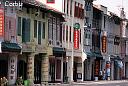
According to the guide book, "one of the nicest things to do on a Sunday morning in Singapore" is to listen to the birds sing in Chinatown. We found it very nice, indeed. On a particular corner, thin wire trellises stand about six feet tall, and have numerous (oops) hanging from the high horizontal cross bars. People bring elaborately carved wooden bird cages with hooks at the top and hang them from the trellises. The owners sit around the patio on benches, sipping coffee and carefully evaluating the performance of their bird and it's neighbors. The birds are hung with others of their own species to encourage more singing. From time to time an owner may move his bird from one location to another, perhaps very close to the old location. A gregarious man, present to try to buy a bird this morning, explained that moving your bird closer to an enthusiastic singer may perk it up if it had seemingly run out of song. He also explained that the elaborately carved cages could cost as much as S$5000! The cages matched the species of bird; tall pointy cages for tall pointy birds, short squat cages for short squat birds.
While listening to the birds, we fell into conversation with the only other traveler present at 8 am, and of course, inquired into each other's plans. When I mentioned the ethical quandry I was in regarding visiting Burma, ie, how to keep the required US$300 each from landing in the hands of the tyrannical regime, he pointed out that it may be possible to do some good in a small way while we are there. So long as we are careful not to do anything or encourage any conversations in ways that would get people in trouble, we may raise spirits by quietly telling people that we are thinking of them and with them in spirit, etc, being aware of what is going on in their country and supporting efforts for democracy. I'd better read some more before we go, but if we can stay in the rural areas with a real goal of bringing caring greetings wherever we go, I'd feel good about our presence.
Chinatown covers a lot of territory in Singapore, which is basically a Chinese modern city, but the Chinatown area is definitely a concentration of the usual herbal medicine, tea, noodle and ginseng shops we're accustomed to in North American Chinatowns. Not as prevalent as at home were the garish gift shops, although if one was determined, one could be successful. We ate like pigs at the huge hawker center. I've discovered a cold beer is just the thing to go with meals to beat the heat. Bob is on juice drinks, but they're too sweet for my palate. I'll probably come home with a belly like Bobby Nordlund's. In Chinatown I used the Asian style toilet for the first time. The holes in the floor were in separate compartments, with the hole in a raised portion of the stall floor so we weren't look at each other under the stall walls as we squated. No paper, of course, but the thing flushed, and outside the stalls the room was equipped with a number of basins plumbed with both hot and cold water for washing. All in all, very high class, compared with what I've read.
Singapore is about 76% Chinese, 15% Malay, and 6.5 % Indian. On Arab Street, the Muslim center of the city, we were probably seeing mostly Malay people, who are almost all Muslim. The highlight of the area is the Sultan Mosque, with bright gold minaret visable above the shop roofs throughout the area. The high class shopping center is fittingly called the Golden Landmark center. As with all the high class shopping areas I've seen, the Golden Landmark Center covers one block with a single building about four stories tall. When you enter the building from any of it's four corners or sides, you see that it is hollow in the center and each level's perimeter is lined with shops facing the center. The market blocks, in contrast to the higher class shopping centers, are about the same sized single buildings, but each level reaches from one side of the building to the other and is filled with scores of little stalls. One floor will be fitted with food hawkers, so the rows of stalls are divided by round tables with several little round stools each bolted to the floor. Another floor will be the fresh food market, a 'wet market' as they are called in Singapore, and sections of the floor will be devoted to fruit, vegetables, meat, or fish. The floor will actually be wet for each vendor's continual washing of goods to sell. Another floor or two (?) market centers is probably devoted to dry goods, with scores of stalls, each named a department store, whose wares ooze into the walkway in front.
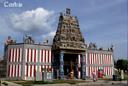
In Little India, the market center was especially lively, with brightly dressed people in saris and vivid aromas from the hawker stalls. I think almost every person of the 6.5% Indian population was present at the market today. In addition to meals at renown Indian restaurants, Little India is the place to get silks, saris, wonderful fresh spices and Hindu gods.
Since we had such a dandy early start today, we were back at the guest house by 2:45, where Bob has been happily snoring away while I made these notes. The clothes we washed out this morning have dried nicely hanging near the fan. I think I'll actually have another shower before we go off to the night safari.
On to the next journal
Back to journal index page
Back to map page
Back to alan's home page